Showing posts with label my special horse. Show all posts

Friday, February 3, 2017

An update on Deli's rehabilitation for kissing spines (and the related issues)

I haven’t ridden my horse since mid-October of 2016 when she received her diagnosis.

Instead I’ve been working on serious rehabilitation exercises 3-4 times a week, along with lots of stretching and strength exercises. The idea is to build up her top-line before I sit on her again, which will help her one kissing spine (the area around the 13th—15th dorsal spinous process). The damage and atrophy to the multifidus muscle as it courses from one spinous process to the next is another matter.

My rehab primarily takes the form of lounging her in the theraband with some kind of equipment to keep her head down. In general I am not a fan of equipment, but she does not reliably stay long-and low on her own and running around with her head up will just exacerbate the problem. So I use a neck stretcher with the theraband wrapped in various positions around her hindquarters.

Using the theraband after a light snowfall.
 It’s a serious workout with the theraband providing resistance. After delays from a massive heel bulb abscess and unusual snowfall that kept me from working her for over a week we have worked our way up to 11 minutes each direction in the theraband (starting from one minute, which was enough to get her breathing heavily in the beginning). Soon, I should be able to hop on her to cool her off after each session.

I’ve been thinking about this issue more. I’ve also, partially by accident, noticed something interesting from looking at old photos. Deli has always had a curvy back versus a straight back (a back with “rock’). However, after she had a traumatic fall about 3-4 years ago and after the subsequent rehabilitation for that, her back became more swayed. In that fall she injured her hip, ribs, and gave herself serious nerve damage in her girth area. Time for easy rehab, acupuncture, and some cold laser brought her back sound. However, now I wonder if possibly she tweaked that area in her back (which may have already been weak due to her upright neck set) or even tore her multifidus during that accident. Any kind of injury to an already weak area could have exacerbated what was already there. Subsequently adding more and more work to condition of endurance led her to strain her lower back because she could NOT use her upper back.
Still the prettiest horse in the barn...

All the times I’ve had her scanned with infrared, adjusted, or worked on, the area of the back where she has kissing spines has never registered as a serious problem area. Now I know.

I think that area was weak (or stuck, or whatever you want to call it) because even before I got her she tended to build up lower back muscle much faster than any of her other top-line muscle. Since she was essentially semi-feral for most of her early life she could have gotten into all sorts of unknown trouble! She is definitely a horse that would have benefited from correct dressage work early on (not so early you would be riding a horse who hasn’t finished growing, of course!).

The rehabilitation will continue. I don’t know yet what kind of riding (if any) she will be up for in the future. I’ll also need another saddle for her if and when I get to that point of the rehabilitation.

Between rehabbing my poor Deli, I’ve been doing other horsey things. One highlight was the Pacific Northwest Endurance Riders (PNER) Conference, at the end of January. I got to see and hang out with a lot of my friends that I don’t always get to see, attend some interesting talks, and even make some cash by selling unneeded tack and horse blankets.


As per usual, I took notes during all the talks I attended. I plan on cleaning up these notes and posting them on this blog over the next couple months. Endurance education coming up!

Friday, November 4, 2016

The end of something (barely started).

It has been a long time.

I keep starting to write an entry and stopping. I am still in a muzzy state of unrest from the recent diagnosis I received for Deli. Unrest and heartbreak.

A couple of months ago after a long-but-slow conditioning ride, Deli presented with some pretty severe back soreness. This was much worse than the muscle soreness she had after her first LD at Mt. Adams. I thought, at first, it was related to a new pad combination I’d tried (since that was the first long ride with the new pad configuration). Then, when it didn’t resolve as expected, I wondered if she had hurt something while bouncing around in the mud trying to avoid a water crossing.

Long story short of it, we’ve been chasing odd back soreness in her lower lumbar region since then. I finally decided to get a back ultrasound after the normal R&R, chiropractic adjustments, and acupuncture did not make a difference. She would get better, but then I’d do an easy ride and the back soreness would flare up again.

Well, the news from the ultrasound was not good: kissing spines and some serious damage multifidus muscle along her spine – right behind her withers.

What is kissing spines? The more technical phrase is “overriding dorsal spinous processes” – essentially this term describes the touching or “kissing” of spinal processes, which are the long thin bones that protrude upward from each vertebrae in horse’s back. It’s likely she has always had this underlying problem because she has always over-built her lower back muscles. Her conformation (that high-headed saddlebred set) likely predisposes this problem in this area of her back. The damage to the multifidus could be acute or chronic. Regardless, time carrying a rider and the increased workload we have had coming into endurance riding has made an underlying pathology become more obviously painful.

You want to get technical? Here are some ultrasound images.

Normal multifidus muscle fiber pattern with some underlying proliferation of bone on a dorsal spinous process. 13th thoracic.

Damage to/atrophy of the multifidus muscle as it courses from one spinous process to the next. Notice the total loss of normal fiber pattern compared to the previous image.


Location where dorsal spinous processes are close-riding or touching. Approximately 13th-15th dorsal spinous processes.
Her lower back region looked great, so my vet rightly determined that being unable to use her upper back properly and is straining her lower back muscles. So the obvious pain is not where the underlying problem is.

In the short term I am working with Deli to try and get her back to lift (by using her abs) in that upper back region. So far, the therapies and ground exercises I’ve tried have been unsuccessful. Our next step is to try mesotherapy, a pain-dampening technique that stimulates the mesoderm, the middle layer of the skin. Our hope is that pain relief will make her more able to build the muscles needed to relive those spinous processes. We are also going to get a theraband (a lounging therapy tool) and continue with massage, acupuncture, and chiropractic work.

In the long term… any more endurance riding is probably out of the question for her. For this, I am heartbroken. She really showed she has the mind and enjoyment for it and I know this is the sport that I want to be involved in over any other. My plan is to try this rehab work for a couple months and see if it seems probable that we could get her strong enough for long trail rides without her always presenting as back sore. 

Then I will need to get a new saddle. Though the edema I was getting with my Ghost saddle didn’t appear painful to palpation, you could see in the ultrasound that it was not superficial and may have been contributing to the multifidus damage and internal pain. I am considering doing the Reactor panel “rent for rehab” program, but the cost of all of that makes me cringe. 

As of right now, if after a couple months of ground therapy it does not look like Deli will be able to be decently sound and comfortable for trail riding I am going to retire her altogether. It’s rough and my heart aches because she is my heart and the one I want to go off and have adventures with. But this pathology means I can’t rely on her comfort. And if it will take 10 hours of doing hard arena work she hates just to get an hour on the trail... I’m not sure that’s worth it. Especially if that would require me buying her a $4k saddle that would set back my financial situation. It will make her so very unhappy. And she isn’t that horse that has a huge work drive – she would be perfectly happy being a pasture puff. With the money I would spend renting an insanely expensive saddle I could easily lease another horse to compete in endurance with. If I had my own property I could probably own another horse, but given the state of the world that’s not going to happen anytime soon! 

On the other hand, if she has just been annoyed by arena work because of this underlying condition the whole time, she may thrive under these therapies. Not enough to do endurance, I’m sure, but it might be enough to justify not retiring her (in part because this condition is chronic and will progress even if she is a pasture puff, and proper work might help her longevity). 

I don’t have to make any decisions yet, but having a “if, then” plan is necessary for me to not otherwise implode from stress. We still have some things to try, but I am preparing myself for the idea that Deli is going to be retired sometime soon.

Sunday, May 22, 2016

Mt. Adams 2016 – we completed our first LD!

We did it! I didn't jinx it! Deli didn't injure herself the day before! She got in the trailer! We arrived intact and rode 30 miles!

Deli and I COMPLETED our first limited distance ride yesterday! We completed 30 miles at the Mount Adams Endurance Ride.

I am so very happy with Deli and had a blast on the trail. The Mt. Adams ride is beautifully run. Which is a good thing, because it is a BIG and BUSY ride (with 68 riders, I believe, in the LD and… 30 started in the 100 miler!). The trail was well-marked and the scenery was absolutely stunning.


At home, waiting to leave.
Deli felt great all day. We dealt with some over-excitement on her part, which was expected for her first ride. She got fairly strong at points (though never out of control) and I was glad I opted for her snaffle bridle over the side-pull. Her power-trot was exhilarating as we wove our way up and up through the forest. It threatened to rain all day, sprinkling on as at times. When we climbed through an old burned out area, the mist crawled in between the blackened trees. At one point we got a close-up view of Mt. Adams’ snowy base. The first loop was long and involved a lot of passing and being passed by other groups of riders. I rode all day with my friend Vanessa and her horse Jinn and had a great time with them.
All vetted in on Friday! With her whole bale of hay...

Deli ties to the trailer overnight for the first time. And Jinn is CUTE.
 Our only trail “mishap” was Deli having a freak out about the first bridge we encountered. She ended up crashing into a downed tree with her hind legs and giving me a brief heart attack. So I hopped off, let folks pass, and examined her for injuries. Miraculously she was totally fine and it was easy to mount again on one of the many downed trees in the forest.


Deli vetted in great at the first check after 16 miles – all As and A minuses. We walked out of camp on a loose rein for the second loop and when I asked to pick up the trot again she was totally game. We were able to find a bubble for a bit in the second loop, and I think this was my favorite time. With a loose reins we mostly let our horses pick the pace, which was typically around a 7mph chugging along trot. At points they picked up the ground eating 10mph trot. For the most part we did not go fast, however, as I had plans to not push Deli too hard. She came back into the camp after another 13 miles still happy to trot forward, ears up. Of course I question her soundness and ability with all the injuries she’s had, so I was very happy with how she moved all day.

The trails (ridden on Friday).
She ate up those hills and seemed to be enjoy the experince! It wasn’t until the last few miles I felt she started to “guard” her right hind a little. She was still moving cleanly, but it did feel like that weak leg was getting tired faster than her other three limbs.

We pulsed in fine and got a completion, ending up with a 43rd place out of 60.

The “bad” things mostly related to her after the ride. The wind was brisk and cold when we pulled tack, and even though I got a cooler on her ASAP she started to cramp along her back and topline. She got Bs on her back on the final vet through and the vet commented that she was stiffening up in the cold. I also thought she was a bit back sore beyond just cramping, to my disappointment. The saddle has been a big question for me (due to that edema – which ironically we had no issues with for this ride) and I hate that she has a sore back. This saddle we have is the MOST comfy I have ever been in tack. In fact, I feel pretty darn good today. A bit of muscle soreness, but no un-right pain (though  I am personally very sleepy from two nights with poor sleep).

The next hour she was eating and drinking great, but she definitely seemed to be stiff and uncomfortable on her topline and generally cramped up just standing around. She was shifting about on her feet. As Deli seemed most comfortable sedately walking around camp and grazing, that’s what we did for about an hour or two after our ride. When she seemed a bit looser I tied her back to the trailer with her bale of hay and a bucket of carrots and went to pass out for a bit in our tent with my husband (who crewed for me like a champ all day).

She did fine overnight but, unfortunately, her back was still sore this morning. I got some advice from riders more experienced than me: that it might just be all the downhill trotting or the exertion (and not the saddle?). If that’s the case the soreness should be gone by tomorrow or the next day. If not, something else may be going on. She didn’t feel fussy or sore-backed at all while I was riding. In fact, she seemed to enjoy herself. Particularly when we were in that bubble I could feel that delightful curious spark she has, wondering what was around the next bend in the trail.

After the ride, trying to keep warm!

My husband was so helpful and wonderful all weekend.

Ride camp this morning.

Deli was perky this morning! Demanding her mash.
She also led a good portion of the way! My submissive weenie of a pony is turning into something else… and I like it! Her worst spook of the day was right when we were coming back into camp from the first loop. Go figure.

I’ll probably post more about the ride later because I’m still mulling over my experiences.


Tuesday, March 1, 2016

GHOST prototype trial: EVA

The month of February has been very busy! I have my notes from the PNER conference mostly written up, but they still need to be edited to make sure they are read-able.

I wanted to get a quick blog post out to talk a little about my experience with the GHOST prototype saddle I’ve been testing out this month.


This prototype – termed EVA – is very different than the other GHOST saddles. It has a “tree” made out of the same material as Crocs. It’s very lightweight and has some flex to it, but is much stiffer than other treeless saddles I’ve seen. It also does not have panels, but they are not needed: this thing has no problem maintaining a vast spine channel even when using a normal pad. Pretty cool, right?

The EVA on Deli (with GHOST pad).

Pony modeling the EVA.
 I did end up needing the pommel bolster insert on the EVA as well to lift up the front of the saddle. As discussed in my trial of the GHOST Firenze, Deli’s conformation means saddles sit downhill on her. Though the EVA looked like it was sitting perfectly with a tight girth, the front of the saddle would squish down when I sat on it – the form is obviously more flexible there.

The front of the saddle. The front does squish down some when rider weight is added.

The pad ties onto the back ring of the saddle. You can kind of see how the seat is Velcroed on in this photo.

The rigging is awesome: adjustable like the other GHOST models, but with a wider spread. This added to front-to-back stability.

These are the rings for the stirrups. Note that they are attached to the tree like other GHOST models to prevent pressure points from the stirrup weight. 
The stirrup position wasn't quite right, to be honest. I ended up in the forward ring like I did with the Firenze, but I did feel like if my legs were even a little more forward it would have been perfect. In part this could be because I was having some discomfort from the seat pommel so maybe I wanted to push my legs out more in front of me. 

 The seat did kinda bust my girly bits in the front, if you know what I mean (I had a similar issue with my County dressage saddle). I think I prefer a flatter seat because of this. And generally my horse isn’t a complete loon – though she has clearly been feeling some spring fever this month. (I think she wants me to start conditioning, right?)
Don't mind our creep barn llama, Flipside...

The EVA with the Thinline.

It felt pretty stable once I switched to using my Thinline endurance pad, though I did notice the back end in particular kicking off to one side or another sometimes. This has been reported with other riders: some side-to-side instability. I think in part this is because the existing GHOST pad wasn’t quite wide enough for the stiffer saddle base on this prototype. I tend to like a pad with a little extra space beyond the saddle footprint and the GHOST pads, in general, are pretty minimalist in that respect. Both my Deli and I are dealing with one-side-weakness problems so it could be a rider/horse problem rather than a saddle problem. It rolled a little, certainly, but I think on a horse with a less pronounced barrel-shaped body and actual withers it wouldn’t be an issue at all (and the roll was about the same as the Firenze, to be honest, and I got some side-to-side roll with my old traditional treed dressage saddle as well). The Thinline had a wider base for the saddle to sit on, so I think that helped. And my horse seemed more comfortable with that pad setup more so that the GHOST pad.


Riding in the EVA! I did not get any arena pictures because my husband only seems to come along during "trail rides" (i.e. walking up the road because everything else is MUD).

At least these roads have some decent hills! I did try different stirrup lengths (this being the shortest).

The seat on the EVA was very secure but I tend to like a flatter seat. People that like to feel like they won’t move when the horse does some crazy antics will like this seat. I did have one crazy antics ride on Deli in this saddle and felt very secure throughout. Deli does not rear or buck, though, so I can’t speak to that kind of misbehavior. Epic spooking and thinking galloping around a slick muddy corner is a good idea is all I can contribute to this test!

The underside of the EVA. The velcro strip down the middle is one way they secure the seat (which you can peel up to add bolsters, or adjust the seat size). This saddle technically is an 18" seat.
I am very curious to see how they develop this. With a somewhat flatter seat and some other minor adjustment, I think I might want one! It feels more like a treed saddle but with the flexibility it could really work for lots of situations. I think, with some work, this could be an awesome saddle for heavyweight riders or riders wanting a stiffer/more secure feel while getting some of the benefits of a treeless saddle.
  
There are some things I preferred about this prototype when compared to the GHOST Firenze I trialed. First and utmost was the wider spread on the rigging. This seemed to help the problems I had with the saddle sliding back were much less with this rigging set up, though I also took the time to adjust my breastplate tighter before I hit the road hills!

I also like that you don’t need a special treeless pad with this saddle. And it's lightweight while still offering the kind of support you might expect for a treed saddle.

I think overall Deli moved more freely in the GHOST Firenze, Which is fine, because I bought a Firenze! It arrived yesterday and I am very pleased. I can't wait to try out my new saddle, especially since I got custom blocks (instead of the bucking rolls) done that I think will work well. This means the EVA prototype is going to be sent along to the next person. The hope is that, since this saddle is still in development, rider feedback will shape the next prototype.

My new GHOST Firenze with custom "banana split" block!
My (newish) cat, Jovian, checking out the custom block.
"What do you mean I can't sit on the new saddle?"
 Fingers crossed this is THE saddle that will get us through lots of trail miles with comfort and happiness. I know I am going to have to play around with bolstering the front and I have plans for pad experimentation (including getting a laminated foam Skito that I can place on TOP of the Thinline pad). If there is an interest in these things I can endeavor to make an effort to catalog them here.

Fingers crossed March is the month where we start conditioning and building fitness for the long haul. I am looking forward to more saddle time and trail riding. So far 2016 has been turbulent with my own health problems and I need the relief some long trots on the horse I love will bring.


Tuesday, February 16, 2016

10 years of Chestnut Mare under my belt… award please?

This week marks our 10th year together.

A cold but sunny day in January, 2016.
I still remember the day Deli stepped off the trailer like it was yesterday. It was my first-ever emergency vet bill! We struggled for the first year and a half together as I worked with her on the ground, teaching her all the things a polite horse should know. I had trained baby horses before, but it was quite the challenge teaching an ADULT horse who’d had little handling how to do the basic things many horse owners take for granted. We also dealt with injury and illness during that time that put the STRESS in stressful.

Recent road riding around our barn.

But each year things have gotten better. We may be older and creakier with past injuries, but we are partners now. She turns 17 in May the day after I turn 32.


Road riding in February.
This horse is a huge challenge. But she also holds a piece of my heart that belongs to nobody else. Even knowing all the pain and hardship we would face in the past ten years I’d do it all again. I think she came into my life for a reason and vice versa.

I'm looking forward to the next ten years with this beautiful individual.

My husband made her a "mash cake."

Friday, October 23, 2015

Don't sweat the small stuff!


  I can’t believe I haven’t done any updating since July! Slacker slacker slacker.

Fall - my favorite season in the PNW - is here.
 The good news is: Deli is doing pretty darn well. The lymphangitis is still a thing but I’ve learned not to sweat the small stuff. Seeing a puffy leg now just means several things:

  • She got bit by an insect and needs a loading dose of antihistamines.
  • She needs more exercise and/or has been standing around too much.

 So far neither of the above have affected her soundness or general comfort.

Look at her leg on a good day! This is incredible considering the trauma this leg has experienced (so my vet tells me).


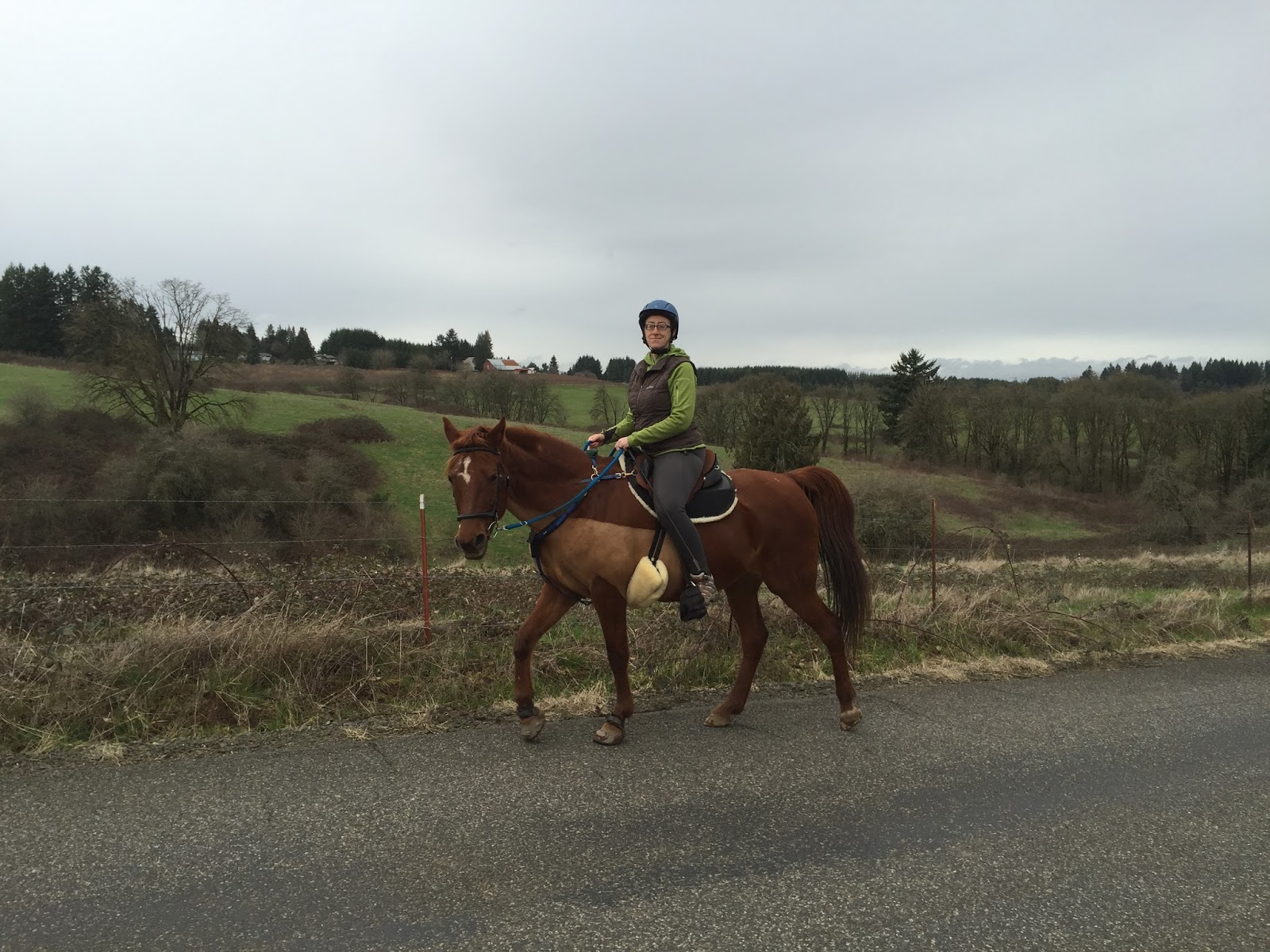
I have been riding her – still bareback (with a pad) – about 3 times a week. We do “trail riding” whenever we can. Just loops around the farm fields across the street, but she enjoys that more than arena work. We have also been doing dressage work in the arena. She is sound and not terribly unfit. Now that the cooler weather and some rain has come to Portland at last the insects are no longer a bother. I’ve been able to take her off daily antihistamines. The fact that those drugs really  help her highlights that she has hyper-immune allergy issues that set off inflammation more than anything.

HAT.

Foggy day on Cow Hill.
I did get Deli tested for Cushings disease this fall and the good news is: she doesn’t have it! We received a big fat (and very clear) negative on the ACTH test. This is a relief for me because her having Cushings would have added another whole management headache. Ironically her top line and the odd fat pads also go better with the use of antihistamines (and perhaps, not using my old custom-fit saddle?!). My vet wants me to watch her heat cycles carefully next spring and have her checked for reproductive issues if I still see some irregularity in her heat cycles.

Brian has even been riding her more!
Despite not having Cushings I still decided to muzzle her this fall. She bloated up HUGE after two days on growing green grass and the muzzle went on. With the drought we have been in this is the first fall season we’ve had where the horses are going from NO grass to the highly sugary fall grass. It’s not even raining much yet but I plan to keep her muzzled until it’s truly winter and the grass is a bit safer. She gets high quality hay 2x a day, her supplements (I’ve added back in some cinnamon since fall is here), and lots of grass snacks as we poke along in the farm fields.

With the muzzle on she now looks good. Oddly she looks less sway-backed since I started just riding her with the bareback pad. And she is FUZZY-PLUSH with her winter coat right now!

I really am trying not to sweat the small stuff. It’s not in my nature but I think it’s about time I adopt this as a policy with my beloved chestnut mare. I push the ache of wanting to do more endurance rides away for the time being and tell myself over and over: what will be will be. The endurance season is just about over in the Pacific Northwest anyway. Next year I hope I can get Deli out more and if not I’ll try and find an appropriate endurance horse to lease or try to find pick-up rides.

I’ll be able to afford it better now because after two years of looking for the right fit I’ve finally found and been hired onto a new job! I’ll be making some predictable money while also doing agricultural policy work – something I am passionate about. It will be reasonable to start looking for a new saddle soon. Maybe down the line we can also invest in a used truck and trailer which will open up opportunities for Deli and I whatever our direction ends up being.

My vet tells me the lymphangitis doesn’t make endurance out of the question: endurance vets are more concerned with a leg that GETS fat than a leg that gets thinner. And soundness, of course. And everything I have seen over the past few months is that the exercise is the best thing for Deli. I hope extensive trail riding (and hopefully camping) is going to be a big part of next year. But with a new job... who knows? I certainly don't!