Showing posts with label dealing with the hoof. Show all posts

Thursday, February 4, 2016

PNER Convention Notes – "10 Things You Can Do Better" by Susan Garlinghouse, DVM, MS

First in my convention-note lineup is a talk given by Dr. Susan Garlinghouse. She is fairly well known in the endurance world for her articles on equine nutrition and other salient topics regarding the health and fitness of our horses.

During this talk she essentially rounded up some of the more interesting things she had found from scientific research, and the practical applications of this recent research. Everything she talked about comes from her reading peer-reviewed research journals (so we don't have to?).

There were several points that are very applicable to Deli and I. I hope making my notes available will be helpful for other riders and horse lovers.


1. How to Feed Feet


There are tons of factors go into growing a good foot – bio-mechanics, genetics, age, breed, metabolic rate, temperature, and moisture (so the season and climate in general matter quite a bit for what a foot needs). Nutrition is a big deal but there is no one thing that is a silver bullet.

The key points from the nutrition standpoint are:
  • Feed enough calories – the quality of their feed might not be high enough. In a positive energy balance they will grow foot 50% faster than horses on a restricted diet (not meaning the horse is on a “diet” for weight control, jut that the horse might be working more than the calorie intake received).
  • Provide a good amino acid profile – don’t just supplement one amino acid and expect it to make a difference (for example, don’t just add methionine).
  • Should you add minerals? If the mineral profile is already adequate, adding more is not going to help (and it might hurt). What’s more important that adding in single minerals is BALANCE. Don’t add a specific mineral unless you have a shown deficiency.
  • Chelation of minerals is when bonded mineral to some kind of protein. This kind of mineral may increase rate of hoof growth. Minerals are absorbed more easily when chelated but it’s going to cost more money. Look for things like “zinc proteinate” or some kind of yeast. Zinc is a good one to be chelated.
  •  Gelatin does not help – it has no scientific influence on hoof growth (And it’s not good for your fingernails either).
  • Adding fat to the diet – adding a generic supplement will not help hoof, but it could help keeping the positive energy balance discussed earlier. However, adding fats high in omega-3 fatty acids IS beneficial for the foot.  This WILL provide direct benefits to their coats and hoof. Essentially these kinds of fats will add increased tensile strength if fed in the right amounts for long enough.
  • Premium commercial feds provide a good vitamin-mineral balance if feeding around 5lbs a day. More cost effective than multiple supplements! For example: LMF Gold.

2. Feeding Biotin (for hoof quality) – it does work!


As for specific supplementation, Susan Garlinghouse discussed biotin extensively (which makes sense – it’s a common additive to hoof supplements). Biotin is one of the more expensive vitamin supplements. Most supplements do not add a lot of this because it’s expensive. The daily requirement for biotin is around 1-2mg/day just for general health. But if you supplement extra (15-20mg/day) you are going to get better hoof quality with some patience...

It will take 6 months to appreciate the difference with the 15-20mg/day dose. In about 9 months you should see a statistical difference (most horses grow out a foot in this timeline). In 33 months you see the increased tensile strength in the foot.

So yes, biotin can help a great deal with “feeding a good foot” if you keep in mind these baselines:
  • Be patient and consistent!
  • Improved quality: 5-7.5mg/day. At 15-20mg/day you see even better quality but no increased growth. At 50mg/day – you will see increased hoof growth. This will be around 15% better growth, plus a higher quality of hoof.
  • Not every horse is going to respond, however. There are other factors that contribute to the hooves growth and strength (you need to have an overall good environment and supplementation before you can get payback).
  • Biotin is a B vitamin (B7) and is not stored in the body – you have to feed supplement 2x a day if you are giving 50mg/day otherwise it will just be “an expensive pee puddle”.
  • Her personal favorite is Paragon Biotin Plus – one scoop is 50mg. It also includes yucca. Yucca in naturally-occurring feed supplement is okay (otherwise it’s on AERC’s prohibited list).
  • I personally recommend HorseTech’s Bioflax20 product. I didn’t know horses should be getting at least 20mg/day of biotin – but looking at the dosages for this product the horse does get the 20mg in the normal dose! The company also has higher doses in other products.

3. Feeding Fat


This topic is one I’ve seen discussed a lot within the endurance community. So, why feed fat? It has 2x the calories that protein and carbohydrates do, and it’s highly digestible! So feeding fat makes it easy to maintain a horse’s body weight.

The vegetable fats are more digestible (about 90%) and animal fats  are somewhat less  digestible (about 75%) because they have an added mineral content. In contrast, forage on average is 50-60% digested. What is not digested is poop, urine, or heat. You need that also, but heat is also a byproduct of exercise. A horse gets very hot during exercise and when their normal cooling process aren’t operating, they can get to a lethal core temperature in <15 minutes.

Feeding fats DECREASES the thermal load! Thermal load is higher in: larger horses, carrying heavier weight, heavily muscled horses. (This will tie into competing the non-Arab in endurance because one of the primary advantages Arabs have is a lower thermal load.)

Fat in the diet also provides glycogen-sparing effect. Glycogen is animal storage form of starch. Glycogen is a big bushy molecule. It’s not efficiently stored compared to adipose tissues so is in very limited supply. This means that feeding fat makes the animal more fuel efficient and Improves glycogen utilization. Once a horse had adapted to a high fat diet (which takes 5-10 weeks) they can still replenish glycogen repletion. High carbs are not something you want to feed a tired horse, so getting horses fat-adapted makes their rebound easier after a tough ride as well.

Fat is a SAFER feed than a lot of grain! Horses get more fuel efficient when exercising using aerobic metabolism processes and when they are used to burning fat, this process is encouraged over anaerobic energy uses. The glycogen sparing effect is also associated with a decrease in respiratory exchange ratio.

The comparison of oxygen consumption to CO2 produced does relate to the glycemic cycle in a horse as well. Adding dietary fats smooth’s out the glycemic/insulin curves from starchy meals, so your horse will have less of an energy rocket-boost and then a corresponding crash. Ideally its better to have sustained energy. Another reason to avoid large swings in the glycemic index is that insulin suppresses the horse’s ability to oxidize fatty acids – and you want them to be oxidizing fatty acids. All of this ties into how you want to feed a horse before a ride: ideally you want to SMOOTH OUT the glycemic/insulin curves.

Other considerations of a high-fat diet in the endurance horse include:
  • Horses on high fat also digest grain better.
  • One thing to note that is perhaps a bit unexpected: horses on generic HIGH fat diet show symptoms of being insulin resistant! However, if you change their diet to include 1-2oz of marine oil daily abolishes IR effect. So with a high fat diet add a little fish oil and add that. Dr. Garlinghouse recommended the product “EO3”, which is a marine oil source.
  • Don’t ever syringe straight oil down the throat as it does not induce the “swallowing” effect and they can easily aspirate it into their lungs.
  • What about the adage that you should stop feeding fat a couple days before an endurance ride? Essentially, fat consumption makes the horse less hungry. You want the horse to be stuffing itself with FORAGE before and during the ride-day as it is the best thing for gut health and water absorption. During the ride you should not add additional fat to their meals. You want your horses hungry whenever you make hay available to them. A horse can’t utilize fat on ride-day anyway. Edit to add another comment from Dr. Garlinghouse: "It's okay to feed a ration that happens to contain significant fats, and it's okay to add a high fat feed, like rice bran, as a flavoring agent. Just don't add a specific fat source, like pouring corn oil on their mash. I generally stop adding additional fats a day or so before a ride." 
  • What about coconut oil? One of the fatty acids in coconut oil is lauric acid – the only other place it’s found is in breast milk. Lauric acid has been linked in some research with cancer fighting properties. But before you get too excited, this is what the actual research said about lauric acid and cancer: one of the metabolic byproducts of it, when put into a lab petri dish the “cancer did not like it.” Does this mean it actually has cancer-fighting properties? No! Essentially just think of coconut as fat a fat source. (It also tastes good and is therefore a palatable fat if your horse is picky.)


4. Chia seed vs. Flax?


These two seed sources are commonly fed to our equine partners and in her talk Dr. Garlinghouse compared them. Actually, she mostly talked about the benefits of feeding flax.

These seeds have equivalent omega-3 content but Chia is twice as expensive (so why buy it?). Flax helps with hoof and hair quality and helps as an anti-inflammatory. It’s good for arthritis and it’s great for horses in the endurance sport because endurance creates a certain amount of inflammation in joints and tendons even if it's not a chronic condition.

So what are the research points for flaxseed in a horse's diet?
  • Every horse should be getting omega-3 fatty acids.
  • Some endurance horses who had metabolic issues did well on 4-5lbs of flax a day (suggesting it's pretty safe for horses with metabolic issues).
  • Lingan is higher in flax than in chia – lingan is a phytochemical structure (ie. An insoluble fiber which just providing bulk).  It does have a weak estrogen-like properties but the Dr.  Garlinghouse assured us that that is near impossible to actually make a measurable difference. She told us a story about a bunch of stallions on a rigorous breeding schedule who needed a lot of calories and were getting 5lbs of ground flax a day without experiencing any fertility issues. Though it has not been tested in horses, lingan can be protective in humans (prostate and breast cancer!).
  • Human grade flax seed is okay to feed to our horses. Golden and brown flax is the same.
  • Don’t over-grind the flax. You degrade the omega-3 if you grind it too much (because it gets too hot). Also, getting it pre-ground is risky. As long as it’s not rancid it will still provide some fat content to the horse, but the omega-3s degrade more quickly. Feed within 10 days/2 weeks. Put it into freezer bags to make it last longer.
  • Flax does have the cyanide precursors that in some bodies do turn into cyanide. But the dose makes the toxin! It is another “cowboy myth” that flax seed is toxic because of these cyanide precursors. How did the myth start? It began– from cows fed linseed cake (which is the same plant but with the oil taken out of it). Cattle have the enzyme to break down the cryogenic precursors and they had some issues arise. Horses do not have this enzyme! Or at least not in high concentrations.
So how much should you feed?
  • For flax: give a cup to 2 cups a day (start at ½ a cup a day or you will get diarrhea) for a horse doing LD or 50s. It’s more palatable than a lot of the oils.
  • What about flaxseed oil? Plain flax seed is 20-25% fat and is a lot less expensive. The oil is harder to keep fresh – it’s very sensitive to light, and needs to be refrigerated.
  • What about grinding flax? You will get 2x the digestibility out of ground (slightly ground). This is different than oats (where grinding does nothing) because flax is a SEED and has a hard hull.
Someone asked about black oil sunflower seeds. For BOSS – good way to get fat into them as a source of calories. But they have more omega-6s than omega-3s (and omega-6s are pro-inflamation). But at a better ratio than most vegetable oils!


5. Feeding Grain to the Endurance Horse


Oats, corn, barley, etc. The main thing to remember about feeding grain is: there is a limit to how much grain horses can digest in a day.

When feeding 5-11lbs of grain a day the risk of colic increases by a significant percentage. Why? Starch meals are digested by enzymes in the small intestine. It is like a conveyor belt and just keeps moving when healthy. When there is too much grain it gets dumped into the cecum. The cecum will treat it like forage because that's what the cecum does!

 Feeding Management of the Equine - eXtension article.
When grain gets to the cecum it makes the environment acidic ( which is called "cecal acidosis"). This condition associated w/ colic, laminitus, endotoxemia, EGUS, and other things you want to avoid in your equine partner. What's more, ulcer medication does not heal ulcers in the hind gut, so you should avoid ulcers as best you can. Dr. Garlinghouse noted that horses with fore gut ulcers often have diagnosed hind gut ulcers.

Other considerations for feeding grain include:
  • Feeding 10lbs of grain a day also decreases fiber digestion.
  • Sub-acute cecal acidosis contributes to decreased appetite.
  • Digestibility NOT improved by splitting a large amounts of grain into many meals.
  • The least digestible grains are corn and others with a very hard casing (the “hard grinds”). There is NO advantage to processing oats or other grain feeds compared to the straight grain (crimping, rolling, etc.). 
  • Commercial feeds do things to grain to make them more digestible, so if you want to feed grain that might be the way to go.
  • With respect to sprouting grains (as in fodder): it does improve digestibility, improves the vitamins the horse can access, and makes it palatable. If the grain is still intact enough to sprout and grow then you know you are getting a high quality grain. 

6. Ride-day Breakfast


  • Re-think 4am grain or concentrate breakfast. Why not? Because you don’t need the energy spurt at the start of the ride. You want the burst later and you don’t want a slump at the “lunch” hour. This does not mean they can't get a mash of soaked pellets or something similar. So give them a flake of alfalfa in the morning. Or soak some pellets of alfalfa. Just to make him happy!
  • The horse should be eating FREE CHOICE forage all day long! And days beforehand. This packs the gut full and will help store water if nothing else.
  • Feed them any concentrates the DAY BEFORE (before midnight). The "lighter fluid" can be filled up the day before and your horse's glycogen stores will be full. And you will skip the glucose-insulin curve with this practice.
  • Make sure he finishes all concentrates before midnight the night before.
  • The only horses that need carbs during the day are the ones being competitive. 

7. Preferred Gait Studies


How does the body mass and distribution of weight affect energy costs? Does reducing mass of a distal limb increase energy efficiency? 

We know there is a linear relation between increasing mass and energy costs. When measured in fit Arab horses, adding 1.5lbs to each ankle increased energy costs by 11%. If the same amount of weight was at the center of gravity increased energy costs by only 0.6%. So every 1lb you add to the legs equals the same energy cost (approximately) as adding 18lbs over the center of gravity (such as tied to the saddle or breast collar). But you don’t get the extra “credit” points when standing for best condition if you have things on your horse's lower limbs.

So what should you do? Essentially, balance hoof protection against unnecessary additional weight! Ask: does my horse really need splint or bell boots? Does he need the heavy shoe or can I find something lighter? Or maybe be dynamic and change the booting and leg protection throughout the ride. For example, if you know the first loop is going to have a lot of brambles or cacti, put on protective boots and then pull them off for the second loop which has more sandy terrain.

(This is one reason it's important to train in the gear you are going to use, too, so your horse get's used to the energy expenditure required in wearing boots.) 

8. The "Sweet Spot" for Gait

Energy costs for the horse rise outside the “sweet spot” – ie. the speeds they are willing to keep up all day long. Most horses will have this for each gait. If the horse chooses their own speed they will usually choose the sweet spot themselves. Where an extended (or collected) gait goes away from the sweet spot we should make them transition to a different gait or else they are expending energy needlessly. The main qualifier for this is that if you have an inexperienced horse they may try and tell you their "sweet spot" isn’t quite what it actually is (I promise, Deli, the sweet spot is not jigging sideways). It's always good to change gears every now and then to use different muscle groups, anyway.

This is another area heart-rate monitors can be very useful. With a heart rate monitor you can tell his "sweet spot" is – that’s where his heart rate will be the lowest at that particular gait. As your horse gets more experienced that sweet spot is going to change. It usually gets faster as a horse gets more fit mentally and physically.

I am really curious to figure out Deli's "sweet spot". She can trot like a demon sometimes (approximately 14mph) but she seems most efficient at 7mph or so. Her walk varies widely, usually slower at the start (2mph) and warming up to 3-3.5mph. Not a fast walker!

9. Joint Supplements

The only joint supplement that is supported by data is Cosaquin. And yet even cosaquin is only about 3-4% bio-available to the horse. Glucosamine and the different sulfite joint supplements are not bioavailble to the horse when ingested. Why? The size of the molecule matters and can't be utilized well by the equine.

Adequan (or Legend) works better because you are bypassing the digestive tract. Adequan is 90% more bio-available. So Dr. Garlinghouse's recommendation is that you get 2 vials of Adequan rather than buying expensive supplements. In the long run this might actually save you money!

Here is another article I found comparing Adequan, Legend, and Pentosan. I'm particularly interested in researching and asking my vet about Pentosan for Deli, as she doesn't have any specific joints that are problematic (just a history of traumatic injury).

10. The best thing to feed DURING the ride is hay! 

You can also feed a lower-glycemic mash (triple crown senior is pretty good for this). As an aside – green grass is MAGIC for horses! If you have access to pasture and your horse is not sugar sensitive, green grass can do wonders to multiple systems in a horse’s body. This includes ride-day.


This is what we do at the end of anything long: a good roll!

That's all for now! Since a lot of what Susan Garlinghouse spoke about related to nutrition, I thought I’d provide a link to an article on nutrition and management made specifically for Green Beans.


Next time: Notes from "Endurance Foot Care" by Sue Summers and Lee Pearce.

Tuesday, November 12, 2013

When I sit astride her, I soar, I am a hawk.


“He leaps from the ground as if his insides were light as hairs. He’s a flying horse, a Pegasus, breathing fire out of his nostrils. When I sit astride him, I soar, I am a hawk. He trots on air. The earth sings when he touches it. The lowest part of his hoof is more musical than Pan’s pipe.” – William Shakespeare, Henry V: Act 3, Scene 7.


Horses inspire poetry because they are poetry. Today I sunk my fingers into Deli’s thick chestnut coat and thought: this is what home feels like. This is where I belong when the fear of the unknown threatens to unseat me.

Granted, I’ve been calling lots of things poetry lately. Legal contracts are poetry to me. Every word, and its placement, has meaning in a legal contract.  Horses are a different kind of poetry – an emotional rather than intellectual delight for the mind and body. Maybe we, as humans, need both types. I certainly do.

The things I do for my horse are somewhat less poetic. Today I paid to have Deli adjusted by a chiropractor, and then to have her hooves trimmed. Later this week she will get dental work and my saddle will be re-fitted to her changed shape. 

On top of those expenses, I’ve started running again with feigned gusto. It’s hard work and I’m not a naturally athletic person! I may not have the trail access I want (and arguably need) to condition Deli up for endurance competitions right now, but that’s no excuse for me to not condition myself up.

And hey, look! I’m barefoot and booted too. Like pony, like willing human servant. I’ve found these funny-looking Vibram shoes are my life-line to fitness: I can walk and even run without every step being painful in these shoes. For a while after being hit by that car I feared that I would never be able to hike or enjoy exercise again, given that every step felt like a knife being stabbed into my hip and knee. With these shoes, the only pain I experience is the good kind: muscles burning with fatigue.

Right now? I’m ready for more adventures. I’m ready to keep living the poetry that is belonging to a chestnut Arabian mare.

In other words: I'm ready to hit the trails and pound out some miles. I think Deli is ready, too.


Friday, September 30, 2011

A minor setback as the Pacific Northwest welcomes in winter.

Our plan had been to sign up for our first ride in August. It was a ride just next door, which I thought would be a good experience for both Deli and I since we could (assuming we could find a ride) go to the ride and then home again when finished. No overnight stay – which neither Deli or I have done yet – required.

I’m sure she would have been ready to do the limited distance (25 miles) at that ride. I was more worried about my own physical ability, but was pretty sure I could pull it off and suffer for it in the week following. She had been doing great on our trail rides, and recovering quickly after doing frequent 8 mile rides that included a decent amount of trotting and 12-13 mile rides at the walk. Our trails behind our barn are extremely hilly and rocky, which limits what we can do. If anything has been an issue, it has been her lack of enthusiasm with moving forward into a trot when we were out by ourselves. This has made it difficult to do proper conditioning. I attributed this to laziness or her normal tendency to be a worrier and didn’t push her much. Since I spent a lot of time walking her in-hand (which I always did for the last big hill up and down) I also trotted her in hand a little.

So for two months we were in trail-heaven. Then I had my masseuse come by to adjust and work on Deli, because I had noticed the inevitable buildup of muscle tension in her hamstrings and pectorals. My masseuse, as I have mentioned before, has this excellent thermography camera. We were both ecstatic to see that Deli’s primary injury of concern – her groin and hamstring tear – was completely gone. As in, the heat signatures matched in all her legs. Unfortunately, the backs of her pasterns on all four feet were inflamed. This was a surprise, because Deli has great leg conformation that includes great medium-length pasterns. She is a smidgen toed out, but it’s barely noticeable unless you know you are looking for it or you have owned her as long as I have. My masseuse wanted me to consider that her workload was too heavy, but that didn’t sit right. Her back and other soft tissue all looked great, with the exception of a rib being slightly out on her right side (and no surprise that this is right under the spot where my bad hip is).

Then it occurred to me – her boots!

The BLM roads are tough on a bare foot.
I’d been riding her with Cavallo Simple Boots for her front feet and Cavallo Sport Boots for her hind feet exclusively almost every time we went out on the trails. The long stretches of harsh gravel BLM roads necessitate the foot protection we had, and I refuse to put shoes on Deli unless she has some traumatic reason for their need. However, the Cavallo boots have a pretty hard leather “lip” in the back. When I considered it more closely, this lip would press into the back of her pastern at some point in her natural footfall, but particularly when she trotted or cantered and picked up her feet more. My masseuse agreed that this interference could definitely be the cause of the inflammation we were seeing on the thermography camera – particularly since every foot had such a freakishly identical pattern.

I’m extremely thankful for the thermography camera spotting this issue before it became serious. For one, you couldn’t feel any heat in her pasterns. Because the inflammation was equal on all four legs, she also wasn’t moving lame at all. Now I believe some of her hesitation to move forward and trot on the trail to be because it was painful, to some degree, to have the boot jabbing into the back of her pasterns.

So our tentative plans to try for our first endurance ride were shelved. My masseuses recommended three weeks of light work, with cold hosing 3x a week, so that’s what we did. And then I started work at a new job while retaining my summer job, meaning my time to ride or do anything other than sit in front of my computer working has evaporated, so she has gotten more like six or seven weeks of light work. The muscle from our summer work is fading from both of us, and I feel somewhat discouraged that things worked out as they did. Particularly since my own fitness and weight is a serious problem going forward with our competitive trail-riding dreams.

On the other hand, the EasybootGlove Wides are finally out, and we have been experimenting with them. It seems they will work well for Deli eventually (when the size we need actually comes into stock!) and I believe they are the better option for trail riding because they do not have any hard “lip” or anything hard at all above the hair line. I feel some wariness that the gaiter (which is completely soft and shouldn’t cause any pressure points) will be a problem because of heat buildup on her pasterns, but hopefully that won’t be a serious problem. We have done some test-rides and I have found Deli is much happier to move forward in the Gloves, so I am hopeful we will be successful using them. If and when we do compete I plan on doing Glove Glue-Ons, if I can.

Front hoof in progress!
In the meantime I have given up completely on farriers after going through seven individuals since moving up to Portland two years ago. Deli has good feet, but they like to flare and my most recent farrier was not taking off enough toe despite my encouragement. She has some white-line separation as a result. Having taking farrier science classes at UC Davis, I’m somewhat handy with a rasp and hoof knife and decided that I need to brush the dust off my old farrier science books and attempt to do her feet myself. In the past I have been worried about hurting Deli or worried about hurting myself, since I have a bad back. After obsessively reading everything I could find about barefoot trimming, I started work.

So far, the results of my work on her feet have been noticeably good. She moves out more comfortably on gravel now, where she would mince before. I’m taking it very slowly for my own comfort and mental health, meaning I trim her a little more each week. It’s more enjoyable than I thought it would be, although all my study has made me realize how many horses are improperly shod! It’s become somewhat of an obsession – I now see a horse’s feet before I take in anything else about the animal.

The Gloves for Deli don’t fit quite like they should because of her toe flare, but they don’t move at all when we walk or trot on rough ground, so I’m going to stick with them. If we have issues, a little “bootlegging” with sport tape should do the trick. The boots are difficult to get on and off, so I'm not anticipating a need for a powerstrap.


Deli finishing up lunch in her shelter.
Also, with my busy schedule I have decided that doing in-hand hikes with Deli is a more productive use of our time. I need the mental break after my long days at the office and the exercise, and she loves being out and about in the forest rather than confined to the arena. I also caved and bought a fancy (and expensive) Skito bareback pad so that we can focus on MY fitness this winter when we do arena work. The pad is made of foam specifically designed to carry the heavier rider because I am constantly conscious that my weight gain since my accident has put me above what Deli is mathematically designed to carry. Again, I keep a sharp eye on her back health and have seen no adverse effects, but it doesn’t hurt to be cautious.

Overall, things continue to move along. We have had setbacks, but Deli is otherwise healthy and I have a plan for my own fitness needs.

Monday, October 4, 2010

No hoof, no horse.

My horse is barefoot.

In simplest terms that means she does not wear shoes. We once experimented with shoes to see if they made any difference in her way of going and had our farrier-of-the-time hot shoe her. 

It didn’t work out.

For one, Deli has incredibly fast growing feet. I think this relates to the fact that before I owned her she basically had free run of a large acreage and for the most part wore her feet down naturally. This means that I would have to re-shoe her every four weeks if I didn’t want her tripping on her face because her natural movement would not wear down the horn of her walls. As it is, if I’m working her on mostly soft surfaces I still have to get her trimmed every four-to-five weeks during the summer (when her feet grow the fastest) to keep them from getting too long.

For another, shoeing contributes to the contraction of the heel and such contraction prevents proper blood exchange up and down the leg. Not to mention the fact that nailing on a shoe weakens the hoof wall. At any rate, we experimented with shoes for two months and haven’t considered them as a viable option since.

Plus, Deli is one of those horses who is lucky to have straight legs and large feet, both of which contribute to her having good feet overall. She is a great candidate for being barefoot the rest of her life.

However, with new goals in our sights I recognized that Deli was going to need some additional protection for her feet. Some of the trails we have access to now are rocky or have a mixed gravel surface; particularly the narrow logging roads that are the trails that will stay nice and ride-able throughout the winter.  Deli has let me know that walking on gravel is uncomfortable – she has yet to get bruised from it, but she picks her way very carefully across any rocky surfaces. Any serious work on these surfaces would also wear her feet down too quickly, resulting in tenderness for her.

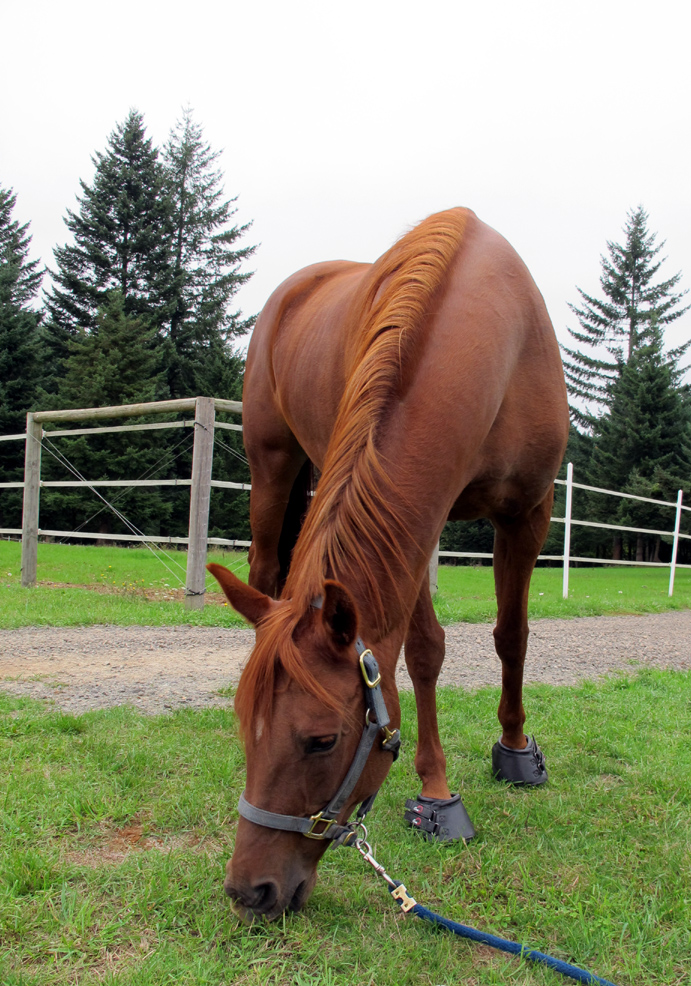
The clear solution was to find a boot that fit Deli well and could be used when we worked on rough ground. After much research I bought a pair of Cavallo Simple Boots. They came with good recommendations, were in the right price range (read: cheap), and my research suggested that they would work well for Deli’s rounder hoof shape. They still seem a little bulky in my eye, but the industrial Velcro rather than wires (that can snap) design seemed simpler and more idiot-proof than other brands. 

So far so good. Our first use of the boots was on a 30 minute hike in-hand through the woods. She didn’t seem bothered by them and she had no rubs or indications that they were too tight or too loose. What I did notice is that she is going to have to adapt to having a “larger” foot – places where she could normally step easily became a bit awkward for her. You could tell it was giving her a brain-funk to have her feet be larger than she was used to. 

The next day we did a somewhat longer hike in-hand with similar results, though Deli was less clumsy overall when navigating uneven footing. The third day I put them on her in the arena so I could see what she was like under-saddle (even though she hardly needed them in the soft footing). She had a bit of a mental breakdown when someone decided to use a weed-whacker, so our ride ended up being longer than planned. However the boots did stay put and did not seem to impede her ability to trot sideways, spin, or shy as only an anxious Arabian can. And no, she wasn't particularly interested in my monotone reminders that she was supposed to be too weak for such athletic maneuvers.

After that we hit the trails in a dripping Oregon mist to cool off her brain and steaming body. In the process we discovered a delightful little trail loop instead of getting lost (as has happened earlier). Overall she had her boots on for about an hour of work. We checked them before heading out on the trails and they seemed to have stayed put remarkably well throughout Deli’s pronking in the arena. And upon removing them at the end of our ride there were no rubs or other indications that they were not fitting. Her feet looked great, and it was clear they had suffered no ill effects from either her arena antics or riding on uneven rough surfaces out on the trails. Success!

And Deli is adapting quickly. She is normally very sure footed, and her adjustment to being with her Cavallo Simple Boots have been impressive. She is happy to move forward on ground that would otherwise make her step more comfortably, which is the whole point behind the boots.

Right now Ms. Deli is due for a trim at the end of this week, so the fact that the boots seem very snug is probably appropriate. The Velcro construction seems pretty solid and easier to clean than I would have thought. I’m planning on getting her rear boots as well if she seems to want them, but so far she is moving quite easily on rough ground without them.

This is probably the first time in the history of Deli and my relationship that something has fit her the first time. She has always been a bit hard to fit for every conceivable piece of horse equipment (blankets, fly masks, saddles…) because apparently thick-bodied Arabians with wide foreheads are not a common horse body type. That and I was in denial for a long time that my 15.2 hand horse would ever need an extra-wide saddle tree (which she does).

Hopefully the Cavallo Simple Boots will continue to impress us with their usefulness for many years to come.