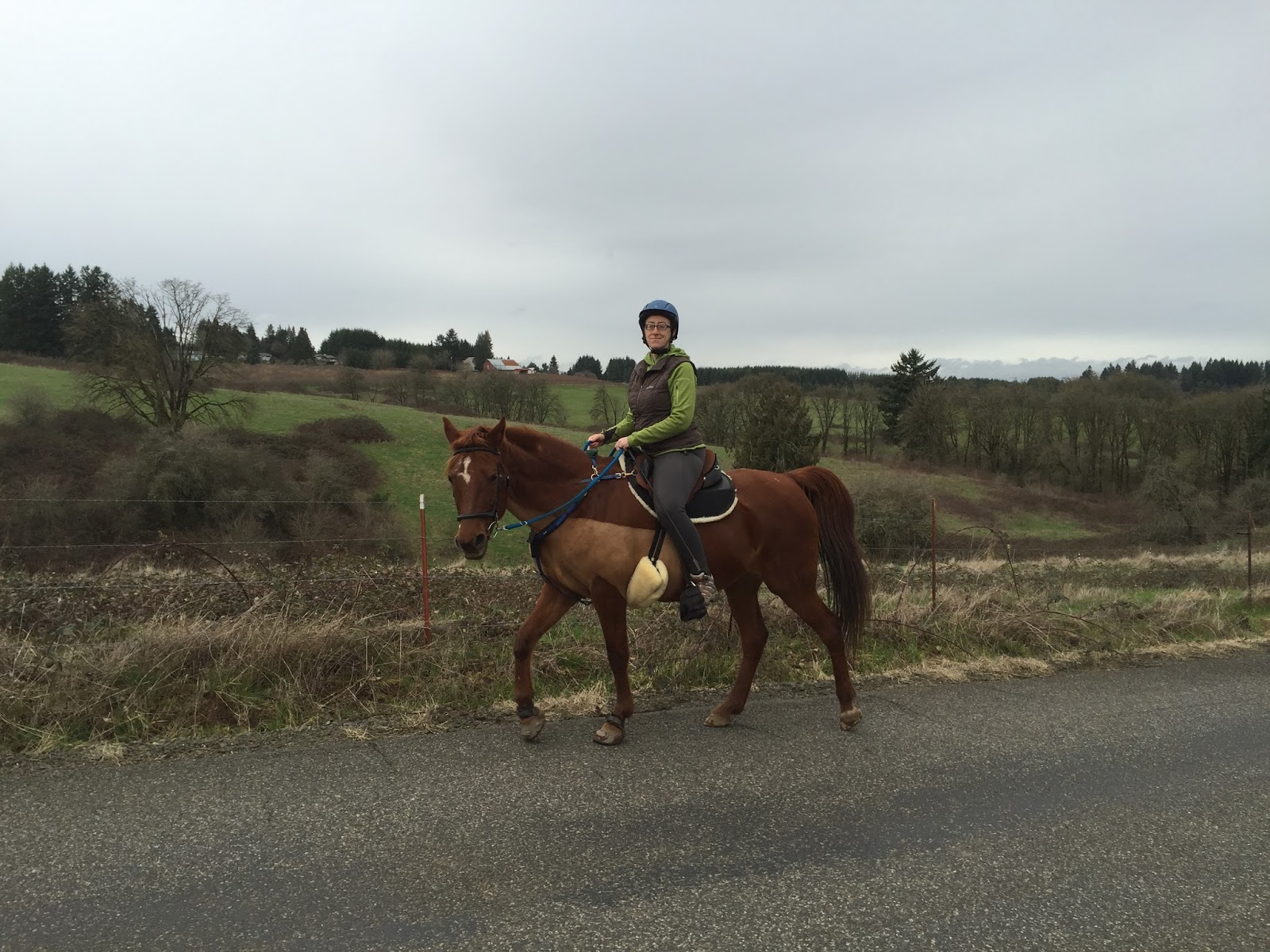
Monday, March 21, 2016

Conditioning in March, 2016 – Ups (and Downs)

Conditioning for the 2016 season has started in earnest. The video below was from my last conditioning ride, also featuring our riding buddies Vanessa and her Arab gelding, Jinn.


In three weeks we’ve had three really successful conditioning rides trailering out to parks with good riding. I’ve been filling in the gaps with arena work (boring, but the local farm roads I will ride on later in the season are still too muddy to traverse).

Last ride I borrowed Vanessa's extra side-pull bridle for half the ride, and Deli went pretty well in it. I like that it does not twist on her face like other side-pulls we've tried.

Grazing break while Vanessa looked for a lost hoof boot in the mud.
There have been some bad points. Mostly: my Deli was an absolute nightmare getting back into my friend’s trailer after one conditioning ride at a local park. She’d been recalcitrant before, but had always gotten on (after our first ride she even hopped on with very little fuss). This time after nearly six hours in the dark and rain, my barn owner offered to rescue us. I’ve never had to be rescued in that way, and I was incredibly humiliated and frustrated. I know the weather and her fear (of a small trailer) had something to do with her behavior (hail and rain, which makes noises on the trailer roof and frightens her) but she was also just being a brat at times.

We rode in the rain, then it cleared up. Then (when we were trying to get back into the pictured trailer) it started raining again.
You know when you work so hard to make your horse a solid citizen and then you have a day where it seems like they willfully forget everything? Yeah. FacePALM.

Deli sure does not look like she's about to fight loading forever, does she?
She just seems to dislike my friend’s trailer (an older Brenderup) and this does not apply to ALL trailers. She loads without much hesitation into an old stock and everything else I’ve tried recently. Though, because I really want to ride with my new friend, this is problematic nonetheless!

Ironically the trail ride before that nightmare was AMAZING. 

Looking out at the Clackamas River.

Deli and Jinn hanging out and being polite like good ponies.

Deli waiting patiently to GET GOING.

I mentioned there was a muddy bit, right?
We have found a conditioning buddy who is, essentially, the perfect match for us. I think we riders get along great and have a lot in common. And Deli and Jinn have quickly become buddies (but without buddy-sourness). As an extra bonus, their paces are similar. Deli seems to truly enjoy these rides. She’s forward, offering to trot along on a loose rein. She really excels at tackling hills and technical footing, though we walk sloooowly for the downhill bits. She seems to recover quickly. During our last ride she drank whenever offered water.

And I'm happy to report that my horse happily leads the pack now. It helps that she isn't nervous about Jinn being behind her. It's lovely!

Our new saddle is comfortable and I just got some NEW wider panels which will hopefully spread my weight out even more. I still have plans to get some Skito foam inserts and other ways to niggle with our tack. For instance, we need to figure out a better system for attaching out trail bags, since my bags are made for an English saddle and don't exactly match my new GHOST saddle.

Deli at home after our most recent conditioning ride. She's looking good for an almost-17-year old mare!

Tuesday, March 8, 2016

PNER Convention Notes – “Beyond Conditioning” – by Robin Ryner

Another day, another long-overdue post of my PNER Convention notes! Fair warning, the following post is LONG (with my personal thoughts in italics for the most part).

Robin Ryner operates Compass Equine, a training center in Arizona. She rides, trains, and teaches.
At the beginning of her panel, Robin Ryner told the audience that her presentation was not a recipe for training horses. Instead, Robin Ryner wanted to give us some of her “ingredients” that we could then use in our own recipes. My general feeling about this talk was that she was giving us a kind of reality-check. It’s one thing to learn all you can about conditioning, feeding, and shoeing the endurance horse – but what about the rest of it? The planning and doing part of endurance riding?

Robin started in endurance in 1998. Though she does not have a lot of competition miles herself, she really enjoys getting a good base on young horses so that those same horses can go down the trail successfully with their owners.

She was right when she stated, “Endurance riders are good at dreams and goals…” I feel like my time as an endurance greenie has been dreaming and making goals for over eight years! With only one LD under my belt, both my goals and my dreams seem hardly achievable. BUT last week I had my first proper conditioning ride of the season, so right now my dreams are hope.

Robin continued by defining exactly what “dreams” and “goals” mean. This is the beginning of that “reality check.” Essentially: dreams are what inspire us, while goals are what get us to those dreams!
  • It does not matter what your dream goal is, but it does have to be specific, measurable, achievable, realistic (time, commitment, and setup?), and time-bound (we have to put some sort of time-limit on them or else it isn’t truly a goal).
  • Make many little goals to get you to your big goal. I like the sentiment that I should make little goals to work up to the big goals, because with an accident prone pony like Deli it feels like those big goals will always be swept out from under us. But I can plan small (even if my dreams remain big).
  • Your chances of succeeding at goals are much higher if you meet smaller steps.
  • Expectations vs. reality: Expectations – a strong belief that something will happen in the future. Expectations get in the way of dreams and goals because they may not mesh with reality. So true. And so cruel, sometimes.
  • Figure out your ultimate objectives (and in-between objectives). If we, as riders and horse owners and endurance riders, don’t know where we are going, how do we know when we’ve arrived? Break things down as concretely as possible so you know when you have met any of your objectives. This may be the signal to move on to the next goal!
  • Be flexible within your goals. And make sure each step is not too big of a jump


Inside your horse's mind..?


Horses are different from us, right? My own learning curve with Deli was helped along immensely when I understood her way of seeing the world better.

Hello, Ponyface.

Robin Ryner went into depth on this topic. In contrast to our human way of obsessing and planning… Horses don’t have goals in the same way. They just want to be comfortable. Consider how we have to break what we are doing with our horses into steps to train them.

Horses live in the moment, of course. And it’s all about them – they are not thinking about you. All they really want is safety, comfort, food, and play (which I qualify as social bonding and social interaction with other horses). Why is this important? Robin Ryder reminds us that the stuff horses do isn’t personal, and we have to frame the times when they are being naughty or pig-headed from that perspective.

As it relates to how horses work with us: be willing to say “no” when you are training. Positive reinforcement is great and should be utilized, but don’t get afraid to say “NO” when they do something wrong, because it gives the horse a clearer picture of what you want. Letting them know when an action is incorrect creates structure and boundaries within which they can learn. And saying “NO” can be done in a polite way.

Robin Ryner does like to use cookies when she trains. (That’s great – so do I. Deli is also a horse who will try and stand on her head for a cookie.) She did qualify this statement by saying that she is not a human vending machine when it comes to treats. Instead, using treats or any kind of reward system is about what finding that horse’s currency is. (For Deli? Cookies.) Leave that horse every day with good feelings towards you, towards work, toward whatever skills or behaviors they need to make that step towards the next goal.

What other considerations should you bring to your dreams and goals when working with and training horses?


Be present. Ride the spine of that horse instead of constantly riding in the far future. When we can feel what is happening in that moment then we can actually abate the problems of the moment much more quickly. To me this means: deal with issues when they arise. I have often heard “ride the horse you have” and I think that applies not just to the individual horse you own but also the horse you have that particular day. Perhaps as a mare guardian I understand this all too well.

What are you starting with? Make sure you know this baseline and use it to plan the goals, both large and small. Figure out the age and level of your horse and how that relates to these goals. What are the horse’s innate characteristics and ingrained behaviors? Are they analytical, calculating, or the anxious type? Or are they unable to control themselves because they are just super exuberant? Or are they a right-brained introvert who is so scared – they want to do everything they can for you but they get scared and the brain turns OFF? Answering some of these questions seems to me like it would make some goals form right then and there. I know a long-term goal of mine has always been to build Deli’s confidence in herself and trust in me. We have come a long way in that respect, but I think it’s going to be a lifetime goal in general.

A horse can have a lot of issues or training holes. No horse in perfect in all circumstances. You say the horse is bomb proof? It probably depends on how big the bomb is!

Time is limited – make it count. We use time pressure problems to disregard training holes our horse(s) may have. Instead of using this as an excuse, deal with issues as they come and soon your list won’t be so big. Train along the way and whittle down all those rough edges, essentially. Always expect that certain things will happen (like your horse behaving as expected) and train them with that expectation. It does not mean they will always behave, but the expectation should always be there. Mounting is a good example. Horses don’t know when it counts (i.e. at a busy ride startup line) so if they haven’t been asked to stand for mounting all the time they don’t know that it’s a rule that should be followed strictly. It’s important to make the most of every opportunity!

This was a very-real tenet to me last week when I spent nearly three hours getting Deli on an unfamiliar trailer. Luckily the owner of the trailer was chill and fine with letting us have the time. Deli was legitimately scared so I'm glad we worked through it.


How can you set yourself up for success? What we do today prepares us for tomorrow. Address your horse’s tendencies on a consistent basis. For example: what happens when you take their buddy away? Better to set them up for success and work them away from their buddies more gradually. But it’s not what we do – it’s what we do when we quit what we were doing. Don’t reward them at the wrong moment; for example, don’t put them back out with the buddy when they are going nuts. If they are very frantic, only remove the buddy by a few feet. It will take time, but you are giving them a better chance of exhibiting the correct behavior.

Make standing quietly a habit. Don’t instantly take them out of the trailer when they start pawing, for example, because essentially they are training YOU to hurry. Prepare the horse to eat and drink better – use different buckets at home, for example.

Create positive experiences. Sign up for clinics, group trail rides, lessons you have to haul to. Use your imagination and make leaving the property fun for the horse!


What kind of relationship do you want? Partnership or a slave? Again, a horse isn’t being naughty because he wants to piss you off. Essentially, be patient and tolerant, and when the horse is being naughty or not doing what you want, try and put yourself in the horse’s shoes.

Desensitizing and sensitizing. The keys are balance and timing – it’s not what we do but when we quit what we are doing. Yes, we can teach the horse to spook. Sometimes all we think about is desensitizing, but sometimes things are not so cut and dry. Be conscious of safety zones and approach and retreat strategies. If a horse is scared or something is going wrong, and you push them and start whacking on them when they react to something with fear, the horse is probably thinking, “See, I knew this was going to be bad.” On the other hand, if you always stay in your safe zones, you will never get anything done – so you have to push that envelope. Knowing this comes from a lot of experience (and knowing your horse!). 

The above is so very very true from my experience. One of my big breakthroughs with Deli was realizing when her “naughty” behavior was from fear or anxiety, and when it was just from her being obstinate. When I could feel the difference, we made huge strides, because I could correct her when she was being naughty, and take more of a calm-leader role when she was scared. I am hardly perfect there, but a lot of the trust we have now is built on me not punishing her when she reacted from anxiety or fear.

You can’t tell things that may be scaring your horse to STOP (like garbage trucks or bikes) but you can teach a horse to face their own fear. From my experience, a large part of this is your horse trusting you when things get dirty.

Where do we start once we have all these ingredients?


We catch, lead, saddle up, ride them, and then put them away. If you consider it, we do most of these things on the ground.

So start on the ground! The moment our horse sees us is when groundwork starts. 
  • Does your horse lead? It’s a more complicated question than you would think. Robin Ryner expects leading to be that the horse will follow you at whatever speed you ask with a mostly slack lead. Remember that everything seems to buckle on the left so your horse may only be responsive on the left! Build a connection with the feet in mind.
  • Grooming and tacking. Hard tying is important, so work on that. Ground tying is super useful in endurance – for instance when you are pulling tack at a vet check. Give a daily once over as well and know what normal for you horse feels like (you can use this to mimic a vet check). (As an aside, when the vet is on the front of your horse checking things out, be on the opposite side so you aren’t in the way. When the vet is on the hind end checking things out, stay on the same side so you can pull their head toward you and get their hind end to move away from the vet.)
  • Mounting. When a horse leaves without you when you are mounting (i.e. does not stands) it’s the same thing as not being to rate them on the trail. The small things build up. Once you get on hurry up and wait. Just slow down and stand there for a few minutes.
  • Warming up (more than just the muscles). One you first get on always do a little warm-up. Check your breaks, check your cues, etc. 

What to do when specific issues arise?


You can condition WHILE training the brain! For example, while doing circles in the arena. You can actually do quite a few miles doing arena work. But yes, it’s boring and mind numbing.

Pacing is a big issue people have. Pacing problems can result from not practicing at home enough! Extend and collect within the gaits, and transition to the different gaits as well. Work on transitioning between the gaits before you work on extending and collecting them within the gait. Essentially good transitions are the key to rating. Work to get a minimum of 3 speeds without tension in each gait. If you don’t release and relax you are coiling a spring then the horse’s body is going to slingshot ahead. Essentially: don’t go into death-grip-mode on them to "control" them!

What about other issues? Spooking, aggression, herd bound, head tossing, bucking, and bolting? There is no recipe for every problem or “grab bag” for every problem. What you want to do is break down each problem into its components (isolate, separate and recombine). Fixing these problems may not happen fast but put it into pieces and work with consistency. For example, desensitize while they are MOVING not just when they are standing still because they will have different reactions.

Coming home or back into camp and having a barn-bound or trailer-bound or horse-bound horse is a common problem. Sometimes you have to be creative in how you come home. Maybe do a couple circles around the trailer and then head back out. Go past the driveway, switch up your loops, don’t always gallop in the exact same place, etc.

And my favorite part: recognize when the horse is trying and reward them for try! 

Modeling our new GHOST saddle.

Race day. How does today differ than any other? 


Figure out where the tolerances are well before the ride day. For example, check their heart rate halfway through. If you want to go fast you don’t have to be going fast – just figure out where you can save time and condition to trot and canter everywhere you can. Average speed is the biggest thing to pay attention to for new riders or riders wanting to bump up their game. If you are riding at a 5mph average pace you are at the back of the pack. You have to train faster at home then on race day because things might go wrong. Go slow to go fast. Steady pacing wins the day (and horse metabolics do play a part as well). 

The everyday things we do don’t really change on race day (regarding the care of the horse), so be mindful of what that everyday care entails.

Protect the horse. Don’t let other riders tailgate! And do not tailgate! Most people are not thinking and are just trying to survive the ride.

Focus your energy. If you want your horse to be relaxed, then you can’t be braced. If your back is hollow the horse’s back is going to be hollow. Essentially: emulate your horse! Loosen everything up – ride the way you want the horses to be. If you need to wiggle in the saddle occasionally and get things moving fluidly, do it.

And above all: Practice your horsemanship every moment of every day.

Be present. Be thoughtful. Be willing to adjust.


Our first conditioning ride of 2016!
Thank you Robin Ryner for your amazing and thought-provoking talk!

Sunday, March 6, 2016

PNER Convention Notes – “Endurance Foot Care” – by Sue Summers and Lee Pearce

One of the talks I attended at the PNER convention in January 2016 was all about the things we put on our horses’ feet to protect them. As most horse people know, the old adage “no foot, no horse” often holds true. And when you are asking your equine partner to carry you for twenty five, fifty, or even a hundred miles, good hoof-care is key!

They started the talk by hammering home the fact that knowledge is not understanding. By using the example of a backwards steering bike (where when you turn the handlebars the wheel turns the opposite direction) they illustrated that once you have a ridged way of thinking, It’s hard, or even impossible to change. A lot of us get stuck in a rut of doing the same thing over and over, believing it will work like we expect it too (this holds true to when we think the same thing is going to work for every horse.). I think the idea that “knowledge is not understanding” is a tenet that I should keep in the back of my mind for other areas of my life.

All endurance horses should have some kind of hoof protection – and what that protection entails depends on terrain, the horse, the nutrition intake, etc! There are so many hoof protection products on the market right now so you have lots of things to try. Both Summers and Pearce told us what products they like to use as farriers. What follows are some pictures I took of different products that were passed around during the presentation (I’ll try and link to the products I recall throughout and I’m sure my readers will chime in about what they recognize as well).

Protecting your horse's feet starts before you saddle up to ride or even consider what protection our horse may need. These were some of overriding themes of this talk:
  • Bad shoeing is going to be cumulative! Horses can lie to you – they may not be moving as efficiently as they could. And you want them to move efficiently in this sport. 
  • The most important part of hoof protection is a GOOD TRIM.
  • The LONG foot is the enemy. Keep everything short and balanced. Essentially this makes it easier for them to move. (Again, it’s all about efficiency.)
  • The environment that foot lives in will affect everything else. For example, crushed heels seem to be common where it is very sandy – because you don’t get that natural dirt pack. Feet packed with dirt isn’t a bad thing. Think of it like Mother Nature’s own pad!

Steel and Metal Shoes

The old standard is, of course, steel shoes. Steel shoes are still in common use and work very well for many horses. Both Pearce and Summers like Triumph steel for when you are not going to be riding through a lot of rocks. Aluminum shoes are good for heavy competition – especially for gaited horses who wing out (because then they have less weight on legs). The biggest issue with aluminum is they wear out quickly.

A Table full of examples!

Glue-on Boots

There are two main brands for glue-on boots right now: Easyboot and Renegade. Sue Summers noted she prefers the Easyboot Glove glue-ons. Renegades are also popular.

It was emphasized that these DO stay on if applied properly! This usually means: Adhere on the wall of the boot and Gooberglue (also called Silkaflex) on the sole of the boot and hoof. Gooberglue dries more slowly and is like a sponge. Horses love it and in the presenters’ experience, horses with this kind of padding in a glue-on shell no longer look for the soft footing on the trail. Summers noted that she applies Durasole before shoe or glue-on. It’s also good for a barefoot horse.

There are some issues to consider with a glue-on shell. For instance, most hind feet are more triangle shaped and most glue-ons are more round shaped. Summers noted that because of this she often has a gap along the edge of the toe she has to fill with glue on the hind feet. Also, the hoof has to be completely dry before you apply them! Another downside is they are hard to take off and are usually one-use only (though people do sand out the excess glue and re-use them, but that’s labor-intensive).

This hoof-needing-to-be-dry issue would be the reason I don’t use them for Deli in her current living situation. She can’t be stalled overnight to get dry and we live on the wet side. Glue-ons would probably only work well during the height of summer on a non-humid day. 

Glue-ons are usually just for a single ride. They can stay on for 2 weeks for a ride and they are fabulous for multi-days. Sue Summers has a tip for glue-ons: she duct-tapes the heel to keep the glue from picking up things in turnout (because it takes around 4 hours to dry).

Here is a video from Easycare showing the process for gluing –on one of their shells. And here is a revised gluing method, also from easy-care. This gives a good idea of what you need to do to glue-on shells!

This is the bottom of a boot used in Tevis.

More wear examples.

Strap-on Boots

Neither of the presenters seemed to be a fan of the strap-on boots and they did not go into depth as to why. Summers noted that the horses seem to move choppier with the strap-ons, giving them a shorter stride. They also mentioned potential issues with rubbing and that you were more likely to lose them.

I do use strap-ons for Deli and plan to continue to in the near future. The Easyboot Gloves, in particular have worked really well for Deli (I have never lost a single one) and I am using Renegades for her hind feet due to an issue with the Gloves not fitting her scarred right hind pastern well. The rubbing can be an issue: our last tough ride the Renegade on one foot did cause a rub. One of my mentors has suggesting using bodyglide next time. Or I may try the Gloves for the hinds again because I’ve found the Easycare products (and customer service) so much more reliable. I'd love to try other things in the future if we do start going to regular rides. As they say: use what works for you!


Composite Shoes

Composite shoes are made from some combination of plastic and possibly metal. Some can be glued on and others can be nailed and/or glued. The general idea of a composite shoe is to get some of the benefits of a traditional steel shoe while getting some of the benefits of a boot (lighter, more shock-absorbing, flexible). In fact the presenters noted that composites in general reduce 65% of the concussion to the foot and they are lighter.

One of the major issues with composite shoes is that the horse’s foot has to be the same shape. Your farrier can’t shape the shoe to fit your horse over a forge. The horses do love the composite shoes – but they have to have a foot that fits the shape of the shoe as it comes!

The “EasyShoe Performance N/G” is a product both Summers and Pearce recommended and passed around. It is quite a clever design, in my opinion: you can glue AND/OR nail (has a metal plate inside it, which give the ridged structure needed for nailing-on). Summers noted that these shoes do last: she knows people that reset them. It seemed like this shoe is versatile based on what the presenters were saying. For example, you can fill the hole in the center with equi-thane adhesive, and you can add spacers to the back of this shoe. The presenters noted that this shoe is really great for horses with contracted heels (especially when utilizing spacers).


Easycare also has other models which are ONLY for gluing-on (Though Pearce noted he sometimes puts nails in them). Unlike the glue-on boots these can stay on for a full trim cycle. 


When comparing glue on boots versus composite shoes:
  • You can keep the glue-on or other composite shoes on for 6 weeks
  • Glue-on boots stay on better, and so are better for an intense ride.
  • At Tevis and other extreme endurance rides glue-on boots have been the most successful. But it you are going to use something new (like a glue-on boot) you don’t want the first time to be at a hardcore ride. Try them out on a 50 first!
  • What should inform your decision if  you are trying to decide between glue-on boots (or strap on) versus a nailed-on shoe versus a composite shoe of some kind?
  • The conformation of the pastern AND the hoof conformation need to be taken into account. When you have long toes and long pastern (especially with weak heels) you are adding a lot more stress with glue-on boots. Why? Because you are extending the breakover and have more leverage.
  • The shape of the hoof will change ability to do composite shoes.
  • Horses that have feet that tend to want to flatten out (pancake) do not do good in composite shoes because they just exaggerates that flattening out trend. Consequently, an upright and contracted will do really well in a composite because it will help the foot to spread out!
Pads & Packing
  • Wedge pads affect bone alignment. These can be used if a horse has bad heel (like a crushed heel) and you have to take heel off to get to better quality horn. However, hopefully wedge pads are always temporary. In fact, they can be detrimental so you have to know what you are doing (so incorporate the veterinarian and get feet x-rayed).
  • Packing under pads usually encourages a thicker sole. Putting a sponge or something in boots will thicken soles up too! However, when you are doing pour-in packing, do not have the cushion or pads so that they are flush with the ground. This can cause sole soreness and pressure points.
  • Summers noted she was a big fan of concussion rim pads (in the front feet in particular).
  • Equipak CS is also a recommended product – it has copper sulfate in it to help with white line and thrush.
  • Leather pads not so useful in endurance – they can get sand and things underneath them and lame the horse easily. This introduction of material defeats the purpose of packing (which is to keep sand and stuff out).
  • Just having a pad makes problems of bacterial growth arise, so always PACK when you are PADDING.
  • Both the presenters love the product: Magic cushion. They note it’s best for horses with sore feet after the ride as a therapeutic treatment.
That's all for now!


Tuesday, March 1, 2016

GHOST prototype trial: EVA

The month of February has been very busy! I have my notes from the PNER conference mostly written up, but they still need to be edited to make sure they are read-able.

I wanted to get a quick blog post out to talk a little about my experience with the GHOST prototype saddle I’ve been testing out this month.


This prototype – termed EVA – is very different than the other GHOST saddles. It has a “tree” made out of the same material as Crocs. It’s very lightweight and has some flex to it, but is much stiffer than other treeless saddles I’ve seen. It also does not have panels, but they are not needed: this thing has no problem maintaining a vast spine channel even when using a normal pad. Pretty cool, right?

The EVA on Deli (with GHOST pad).

Pony modeling the EVA.
 I did end up needing the pommel bolster insert on the EVA as well to lift up the front of the saddle. As discussed in my trial of the GHOST Firenze, Deli’s conformation means saddles sit downhill on her. Though the EVA looked like it was sitting perfectly with a tight girth, the front of the saddle would squish down when I sat on it – the form is obviously more flexible there.

The front of the saddle. The front does squish down some when rider weight is added.

The pad ties onto the back ring of the saddle. You can kind of see how the seat is Velcroed on in this photo.

The rigging is awesome: adjustable like the other GHOST models, but with a wider spread. This added to front-to-back stability.

These are the rings for the stirrups. Note that they are attached to the tree like other GHOST models to prevent pressure points from the stirrup weight. 
The stirrup position wasn't quite right, to be honest. I ended up in the forward ring like I did with the Firenze, but I did feel like if my legs were even a little more forward it would have been perfect. In part this could be because I was having some discomfort from the seat pommel so maybe I wanted to push my legs out more in front of me. 

 The seat did kinda bust my girly bits in the front, if you know what I mean (I had a similar issue with my County dressage saddle). I think I prefer a flatter seat because of this. And generally my horse isn’t a complete loon – though she has clearly been feeling some spring fever this month. (I think she wants me to start conditioning, right?)
Don't mind our creep barn llama, Flipside...

The EVA with the Thinline.

It felt pretty stable once I switched to using my Thinline endurance pad, though I did notice the back end in particular kicking off to one side or another sometimes. This has been reported with other riders: some side-to-side instability. I think in part this is because the existing GHOST pad wasn’t quite wide enough for the stiffer saddle base on this prototype. I tend to like a pad with a little extra space beyond the saddle footprint and the GHOST pads, in general, are pretty minimalist in that respect. Both my Deli and I are dealing with one-side-weakness problems so it could be a rider/horse problem rather than a saddle problem. It rolled a little, certainly, but I think on a horse with a less pronounced barrel-shaped body and actual withers it wouldn’t be an issue at all (and the roll was about the same as the Firenze, to be honest, and I got some side-to-side roll with my old traditional treed dressage saddle as well). The Thinline had a wider base for the saddle to sit on, so I think that helped. And my horse seemed more comfortable with that pad setup more so that the GHOST pad.


Riding in the EVA! I did not get any arena pictures because my husband only seems to come along during "trail rides" (i.e. walking up the road because everything else is MUD).

At least these roads have some decent hills! I did try different stirrup lengths (this being the shortest).

The seat on the EVA was very secure but I tend to like a flatter seat. People that like to feel like they won’t move when the horse does some crazy antics will like this seat. I did have one crazy antics ride on Deli in this saddle and felt very secure throughout. Deli does not rear or buck, though, so I can’t speak to that kind of misbehavior. Epic spooking and thinking galloping around a slick muddy corner is a good idea is all I can contribute to this test!

The underside of the EVA. The velcro strip down the middle is one way they secure the seat (which you can peel up to add bolsters, or adjust the seat size). This saddle technically is an 18" seat.
I am very curious to see how they develop this. With a somewhat flatter seat and some other minor adjustment, I think I might want one! It feels more like a treed saddle but with the flexibility it could really work for lots of situations. I think, with some work, this could be an awesome saddle for heavyweight riders or riders wanting a stiffer/more secure feel while getting some of the benefits of a treeless saddle.
  
There are some things I preferred about this prototype when compared to the GHOST Firenze I trialed. First and utmost was the wider spread on the rigging. This seemed to help the problems I had with the saddle sliding back were much less with this rigging set up, though I also took the time to adjust my breastplate tighter before I hit the road hills!

I also like that you don’t need a special treeless pad with this saddle. And it's lightweight while still offering the kind of support you might expect for a treed saddle.

I think overall Deli moved more freely in the GHOST Firenze, Which is fine, because I bought a Firenze! It arrived yesterday and I am very pleased. I can't wait to try out my new saddle, especially since I got custom blocks (instead of the bucking rolls) done that I think will work well. This means the EVA prototype is going to be sent along to the next person. The hope is that, since this saddle is still in development, rider feedback will shape the next prototype.

My new GHOST Firenze with custom "banana split" block!
My (newish) cat, Jovian, checking out the custom block.
"What do you mean I can't sit on the new saddle?"
 Fingers crossed this is THE saddle that will get us through lots of trail miles with comfort and happiness. I know I am going to have to play around with bolstering the front and I have plans for pad experimentation (including getting a laminated foam Skito that I can place on TOP of the Thinline pad). If there is an interest in these things I can endeavor to make an effort to catalog them here.

Fingers crossed March is the month where we start conditioning and building fitness for the long haul. I am looking forward to more saddle time and trail riding. So far 2016 has been turbulent with my own health problems and I need the relief some long trots on the horse I love will bring.


Tuesday, February 16, 2016

10 years of Chestnut Mare under my belt… award please?

This week marks our 10th year together.

A cold but sunny day in January, 2016.
I still remember the day Deli stepped off the trailer like it was yesterday. It was my first-ever emergency vet bill! We struggled for the first year and a half together as I worked with her on the ground, teaching her all the things a polite horse should know. I had trained baby horses before, but it was quite the challenge teaching an ADULT horse who’d had little handling how to do the basic things many horse owners take for granted. We also dealt with injury and illness during that time that put the STRESS in stressful.

Recent road riding around our barn.

But each year things have gotten better. We may be older and creakier with past injuries, but we are partners now. She turns 17 in May the day after I turn 32.


Road riding in February.
This horse is a huge challenge. But she also holds a piece of my heart that belongs to nobody else. Even knowing all the pain and hardship we would face in the past ten years I’d do it all again. I think she came into my life for a reason and vice versa.

I'm looking forward to the next ten years with this beautiful individual.

My husband made her a "mash cake."

Thursday, February 4, 2016

PNER Convention Notes – "10 Things You Can Do Better" by Susan Garlinghouse, DVM, MS

First in my convention-note lineup is a talk given by Dr. Susan Garlinghouse. She is fairly well known in the endurance world for her articles on equine nutrition and other salient topics regarding the health and fitness of our horses.

During this talk she essentially rounded up some of the more interesting things she had found from scientific research, and the practical applications of this recent research. Everything she talked about comes from her reading peer-reviewed research journals (so we don't have to?).

There were several points that are very applicable to Deli and I. I hope making my notes available will be helpful for other riders and horse lovers.


1. How to Feed Feet


There are tons of factors go into growing a good foot – bio-mechanics, genetics, age, breed, metabolic rate, temperature, and moisture (so the season and climate in general matter quite a bit for what a foot needs). Nutrition is a big deal but there is no one thing that is a silver bullet.

The key points from the nutrition standpoint are:
  • Feed enough calories – the quality of their feed might not be high enough. In a positive energy balance they will grow foot 50% faster than horses on a restricted diet (not meaning the horse is on a “diet” for weight control, jut that the horse might be working more than the calorie intake received).
  • Provide a good amino acid profile – don’t just supplement one amino acid and expect it to make a difference (for example, don’t just add methionine).
  • Should you add minerals? If the mineral profile is already adequate, adding more is not going to help (and it might hurt). What’s more important that adding in single minerals is BALANCE. Don’t add a specific mineral unless you have a shown deficiency.
  • Chelation of minerals is when bonded mineral to some kind of protein. This kind of mineral may increase rate of hoof growth. Minerals are absorbed more easily when chelated but it’s going to cost more money. Look for things like “zinc proteinate” or some kind of yeast. Zinc is a good one to be chelated.
  •  Gelatin does not help – it has no scientific influence on hoof growth (And it’s not good for your fingernails either).
  • Adding fat to the diet – adding a generic supplement will not help hoof, but it could help keeping the positive energy balance discussed earlier. However, adding fats high in omega-3 fatty acids IS beneficial for the foot.  This WILL provide direct benefits to their coats and hoof. Essentially these kinds of fats will add increased tensile strength if fed in the right amounts for long enough.
  • Premium commercial feds provide a good vitamin-mineral balance if feeding around 5lbs a day. More cost effective than multiple supplements! For example: LMF Gold.

2. Feeding Biotin (for hoof quality) – it does work!


As for specific supplementation, Susan Garlinghouse discussed biotin extensively (which makes sense – it’s a common additive to hoof supplements). Biotin is one of the more expensive vitamin supplements. Most supplements do not add a lot of this because it’s expensive. The daily requirement for biotin is around 1-2mg/day just for general health. But if you supplement extra (15-20mg/day) you are going to get better hoof quality with some patience...

It will take 6 months to appreciate the difference with the 15-20mg/day dose. In about 9 months you should see a statistical difference (most horses grow out a foot in this timeline). In 33 months you see the increased tensile strength in the foot.

So yes, biotin can help a great deal with “feeding a good foot” if you keep in mind these baselines:
  • Be patient and consistent!
  • Improved quality: 5-7.5mg/day. At 15-20mg/day you see even better quality but no increased growth. At 50mg/day – you will see increased hoof growth. This will be around 15% better growth, plus a higher quality of hoof.
  • Not every horse is going to respond, however. There are other factors that contribute to the hooves growth and strength (you need to have an overall good environment and supplementation before you can get payback).
  • Biotin is a B vitamin (B7) and is not stored in the body – you have to feed supplement 2x a day if you are giving 50mg/day otherwise it will just be “an expensive pee puddle”.
  • Her personal favorite is Paragon Biotin Plus – one scoop is 50mg. It also includes yucca. Yucca in naturally-occurring feed supplement is okay (otherwise it’s on AERC’s prohibited list).
  • I personally recommend HorseTech’s Bioflax20 product. I didn’t know horses should be getting at least 20mg/day of biotin – but looking at the dosages for this product the horse does get the 20mg in the normal dose! The company also has higher doses in other products.

3. Feeding Fat


This topic is one I’ve seen discussed a lot within the endurance community. So, why feed fat? It has 2x the calories that protein and carbohydrates do, and it’s highly digestible! So feeding fat makes it easy to maintain a horse’s body weight.

The vegetable fats are more digestible (about 90%) and animal fats  are somewhat less  digestible (about 75%) because they have an added mineral content. In contrast, forage on average is 50-60% digested. What is not digested is poop, urine, or heat. You need that also, but heat is also a byproduct of exercise. A horse gets very hot during exercise and when their normal cooling process aren’t operating, they can get to a lethal core temperature in <15 minutes.

Feeding fats DECREASES the thermal load! Thermal load is higher in: larger horses, carrying heavier weight, heavily muscled horses. (This will tie into competing the non-Arab in endurance because one of the primary advantages Arabs have is a lower thermal load.)

Fat in the diet also provides glycogen-sparing effect. Glycogen is animal storage form of starch. Glycogen is a big bushy molecule. It’s not efficiently stored compared to adipose tissues so is in very limited supply. This means that feeding fat makes the animal more fuel efficient and Improves glycogen utilization. Once a horse had adapted to a high fat diet (which takes 5-10 weeks) they can still replenish glycogen repletion. High carbs are not something you want to feed a tired horse, so getting horses fat-adapted makes their rebound easier after a tough ride as well.

Fat is a SAFER feed than a lot of grain! Horses get more fuel efficient when exercising using aerobic metabolism processes and when they are used to burning fat, this process is encouraged over anaerobic energy uses. The glycogen sparing effect is also associated with a decrease in respiratory exchange ratio.

The comparison of oxygen consumption to CO2 produced does relate to the glycemic cycle in a horse as well. Adding dietary fats smooth’s out the glycemic/insulin curves from starchy meals, so your horse will have less of an energy rocket-boost and then a corresponding crash. Ideally its better to have sustained energy. Another reason to avoid large swings in the glycemic index is that insulin suppresses the horse’s ability to oxidize fatty acids – and you want them to be oxidizing fatty acids. All of this ties into how you want to feed a horse before a ride: ideally you want to SMOOTH OUT the glycemic/insulin curves.

Other considerations of a high-fat diet in the endurance horse include:
  • Horses on high fat also digest grain better.
  • One thing to note that is perhaps a bit unexpected: horses on generic HIGH fat diet show symptoms of being insulin resistant! However, if you change their diet to include 1-2oz of marine oil daily abolishes IR effect. So with a high fat diet add a little fish oil and add that. Dr. Garlinghouse recommended the product “EO3”, which is a marine oil source.
  • Don’t ever syringe straight oil down the throat as it does not induce the “swallowing” effect and they can easily aspirate it into their lungs.
  • What about the adage that you should stop feeding fat a couple days before an endurance ride? Essentially, fat consumption makes the horse less hungry. You want the horse to be stuffing itself with FORAGE before and during the ride-day as it is the best thing for gut health and water absorption. During the ride you should not add additional fat to their meals. You want your horses hungry whenever you make hay available to them. A horse can’t utilize fat on ride-day anyway. Edit to add another comment from Dr. Garlinghouse: "It's okay to feed a ration that happens to contain significant fats, and it's okay to add a high fat feed, like rice bran, as a flavoring agent. Just don't add a specific fat source, like pouring corn oil on their mash. I generally stop adding additional fats a day or so before a ride." 
  • What about coconut oil? One of the fatty acids in coconut oil is lauric acid – the only other place it’s found is in breast milk. Lauric acid has been linked in some research with cancer fighting properties. But before you get too excited, this is what the actual research said about lauric acid and cancer: one of the metabolic byproducts of it, when put into a lab petri dish the “cancer did not like it.” Does this mean it actually has cancer-fighting properties? No! Essentially just think of coconut as fat a fat source. (It also tastes good and is therefore a palatable fat if your horse is picky.)


4. Chia seed vs. Flax?


These two seed sources are commonly fed to our equine partners and in her talk Dr. Garlinghouse compared them. Actually, she mostly talked about the benefits of feeding flax.

These seeds have equivalent omega-3 content but Chia is twice as expensive (so why buy it?). Flax helps with hoof and hair quality and helps as an anti-inflammatory. It’s good for arthritis and it’s great for horses in the endurance sport because endurance creates a certain amount of inflammation in joints and tendons even if it's not a chronic condition.

So what are the research points for flaxseed in a horse's diet?
  • Every horse should be getting omega-3 fatty acids.
  • Some endurance horses who had metabolic issues did well on 4-5lbs of flax a day (suggesting it's pretty safe for horses with metabolic issues).
  • Lingan is higher in flax than in chia – lingan is a phytochemical structure (ie. An insoluble fiber which just providing bulk).  It does have a weak estrogen-like properties but the Dr.  Garlinghouse assured us that that is near impossible to actually make a measurable difference. She told us a story about a bunch of stallions on a rigorous breeding schedule who needed a lot of calories and were getting 5lbs of ground flax a day without experiencing any fertility issues. Though it has not been tested in horses, lingan can be protective in humans (prostate and breast cancer!).
  • Human grade flax seed is okay to feed to our horses. Golden and brown flax is the same.
  • Don’t over-grind the flax. You degrade the omega-3 if you grind it too much (because it gets too hot). Also, getting it pre-ground is risky. As long as it’s not rancid it will still provide some fat content to the horse, but the omega-3s degrade more quickly. Feed within 10 days/2 weeks. Put it into freezer bags to make it last longer.
  • Flax does have the cyanide precursors that in some bodies do turn into cyanide. But the dose makes the toxin! It is another “cowboy myth” that flax seed is toxic because of these cyanide precursors. How did the myth start? It began– from cows fed linseed cake (which is the same plant but with the oil taken out of it). Cattle have the enzyme to break down the cryogenic precursors and they had some issues arise. Horses do not have this enzyme! Or at least not in high concentrations.
So how much should you feed?
  • For flax: give a cup to 2 cups a day (start at ½ a cup a day or you will get diarrhea) for a horse doing LD or 50s. It’s more palatable than a lot of the oils.
  • What about flaxseed oil? Plain flax seed is 20-25% fat and is a lot less expensive. The oil is harder to keep fresh – it’s very sensitive to light, and needs to be refrigerated.
  • What about grinding flax? You will get 2x the digestibility out of ground (slightly ground). This is different than oats (where grinding does nothing) because flax is a SEED and has a hard hull.
Someone asked about black oil sunflower seeds. For BOSS – good way to get fat into them as a source of calories. But they have more omega-6s than omega-3s (and omega-6s are pro-inflamation). But at a better ratio than most vegetable oils!


5. Feeding Grain to the Endurance Horse


Oats, corn, barley, etc. The main thing to remember about feeding grain is: there is a limit to how much grain horses can digest in a day.

When feeding 5-11lbs of grain a day the risk of colic increases by a significant percentage. Why? Starch meals are digested by enzymes in the small intestine. It is like a conveyor belt and just keeps moving when healthy. When there is too much grain it gets dumped into the cecum. The cecum will treat it like forage because that's what the cecum does!

 Feeding Management of the Equine - eXtension article.
When grain gets to the cecum it makes the environment acidic ( which is called "cecal acidosis"). This condition associated w/ colic, laminitus, endotoxemia, EGUS, and other things you want to avoid in your equine partner. What's more, ulcer medication does not heal ulcers in the hind gut, so you should avoid ulcers as best you can. Dr. Garlinghouse noted that horses with fore gut ulcers often have diagnosed hind gut ulcers.

Other considerations for feeding grain include:
  • Feeding 10lbs of grain a day also decreases fiber digestion.
  • Sub-acute cecal acidosis contributes to decreased appetite.
  • Digestibility NOT improved by splitting a large amounts of grain into many meals.
  • The least digestible grains are corn and others with a very hard casing (the “hard grinds”). There is NO advantage to processing oats or other grain feeds compared to the straight grain (crimping, rolling, etc.). 
  • Commercial feeds do things to grain to make them more digestible, so if you want to feed grain that might be the way to go.
  • With respect to sprouting grains (as in fodder): it does improve digestibility, improves the vitamins the horse can access, and makes it palatable. If the grain is still intact enough to sprout and grow then you know you are getting a high quality grain. 

6. Ride-day Breakfast


  • Re-think 4am grain or concentrate breakfast. Why not? Because you don’t need the energy spurt at the start of the ride. You want the burst later and you don’t want a slump at the “lunch” hour. This does not mean they can't get a mash of soaked pellets or something similar. So give them a flake of alfalfa in the morning. Or soak some pellets of alfalfa. Just to make him happy!
  • The horse should be eating FREE CHOICE forage all day long! And days beforehand. This packs the gut full and will help store water if nothing else.
  • Feed them any concentrates the DAY BEFORE (before midnight). The "lighter fluid" can be filled up the day before and your horse's glycogen stores will be full. And you will skip the glucose-insulin curve with this practice.
  • Make sure he finishes all concentrates before midnight the night before.
  • The only horses that need carbs during the day are the ones being competitive. 

7. Preferred Gait Studies


How does the body mass and distribution of weight affect energy costs? Does reducing mass of a distal limb increase energy efficiency? 

We know there is a linear relation between increasing mass and energy costs. When measured in fit Arab horses, adding 1.5lbs to each ankle increased energy costs by 11%. If the same amount of weight was at the center of gravity increased energy costs by only 0.6%. So every 1lb you add to the legs equals the same energy cost (approximately) as adding 18lbs over the center of gravity (such as tied to the saddle or breast collar). But you don’t get the extra “credit” points when standing for best condition if you have things on your horse's lower limbs.

So what should you do? Essentially, balance hoof protection against unnecessary additional weight! Ask: does my horse really need splint or bell boots? Does he need the heavy shoe or can I find something lighter? Or maybe be dynamic and change the booting and leg protection throughout the ride. For example, if you know the first loop is going to have a lot of brambles or cacti, put on protective boots and then pull them off for the second loop which has more sandy terrain.

(This is one reason it's important to train in the gear you are going to use, too, so your horse get's used to the energy expenditure required in wearing boots.) 

8. The "Sweet Spot" for Gait

Energy costs for the horse rise outside the “sweet spot” – ie. the speeds they are willing to keep up all day long. Most horses will have this for each gait. If the horse chooses their own speed they will usually choose the sweet spot themselves. Where an extended (or collected) gait goes away from the sweet spot we should make them transition to a different gait or else they are expending energy needlessly. The main qualifier for this is that if you have an inexperienced horse they may try and tell you their "sweet spot" isn’t quite what it actually is (I promise, Deli, the sweet spot is not jigging sideways). It's always good to change gears every now and then to use different muscle groups, anyway.

This is another area heart-rate monitors can be very useful. With a heart rate monitor you can tell his "sweet spot" is – that’s where his heart rate will be the lowest at that particular gait. As your horse gets more experienced that sweet spot is going to change. It usually gets faster as a horse gets more fit mentally and physically.

I am really curious to figure out Deli's "sweet spot". She can trot like a demon sometimes (approximately 14mph) but she seems most efficient at 7mph or so. Her walk varies widely, usually slower at the start (2mph) and warming up to 3-3.5mph. Not a fast walker!

9. Joint Supplements

The only joint supplement that is supported by data is Cosaquin. And yet even cosaquin is only about 3-4% bio-available to the horse. Glucosamine and the different sulfite joint supplements are not bioavailble to the horse when ingested. Why? The size of the molecule matters and can't be utilized well by the equine.

Adequan (or Legend) works better because you are bypassing the digestive tract. Adequan is 90% more bio-available. So Dr. Garlinghouse's recommendation is that you get 2 vials of Adequan rather than buying expensive supplements. In the long run this might actually save you money!

Here is another article I found comparing Adequan, Legend, and Pentosan. I'm particularly interested in researching and asking my vet about Pentosan for Deli, as she doesn't have any specific joints that are problematic (just a history of traumatic injury).

10. The best thing to feed DURING the ride is hay! 

You can also feed a lower-glycemic mash (triple crown senior is pretty good for this). As an aside – green grass is MAGIC for horses! If you have access to pasture and your horse is not sugar sensitive, green grass can do wonders to multiple systems in a horse’s body. This includes ride-day.


This is what we do at the end of anything long: a good roll!

That's all for now! Since a lot of what Susan Garlinghouse spoke about related to nutrition, I thought I’d provide a link to an article on nutrition and management made specifically for Green Beans.


Next time: Notes from "Endurance Foot Care" by Sue Summers and Lee Pearce.